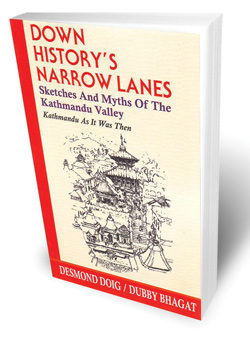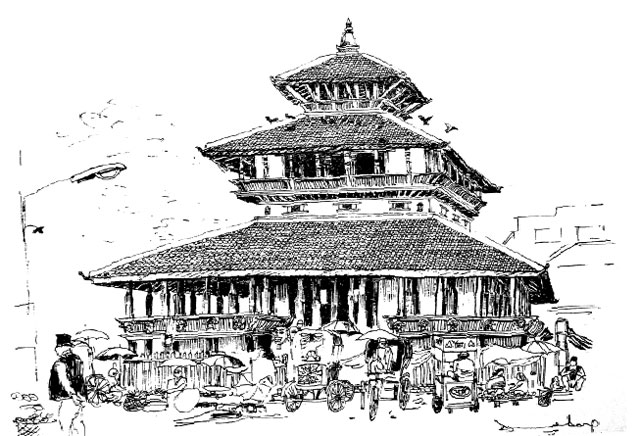
Just a few pages into Down History’s Narrow Lanes a sense of melancholy sets in, a feeling of loss wells up. Turning a page, we find that Desmond Doig’s exquisite line drawing of iconic Kasthamandap (right) is in the past tense.
Doig painted and drew a Kathmandu Valley he loved to accompany text researched by Dubby Bhagat about the temples and shrines that were slowly being blotted by urbanisation. Now they lie largely in ruins after the April earthquake. Doig died in 1983, but left his sketches as a testament to the value of our civilisation in two books, Down History’s Narrow Lanes and the larger coffee table edition, My Kind of Kathmandu.
But what earthquake couldn’t take from us are our heritage, festivals, and way of life. What it couldn’t shake is our faith. Doig was a renaissance man, and understood Nepal better than most Nepalis know themselves and their culture.
Thirty years ago, he wrote: ‘Every monument in Kathmandu has a myth, every temple tells a tale.’ The Valley people still derive their rituals and festivals from them and their lives are irrevocably connected to them. The temples are just symbols, they may have come down, but the Gods in it are safe.
The Machhindranath festival would have been in full swing at this time of the year, but the chariot is still in Chyasikot, exactly where it came to a halt on 25 April.
Popular myths of doom and destruction have always surrounded Machhindranath if the journey is disrupted for any reason. In the chapter ‘The Jewelled Gift of a Snake God’ Doig and Bhagat take us on a journey to discover the myth of Machhindranath, the story of the fabled bhoto, and how a deity from Assam came to be associated with life-giving rain.
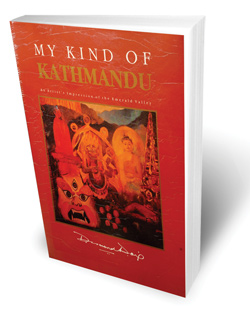
By Desmond Doig and Dubby Bhagat
Harper Collins India 1994
For many Nepalis, Dharara was a monument that represented Kathmandu. When it came down, killing at least 60 people, the symbol vanished. There were stories of tragic, chance deaths and also tales of miraculous survivals. Doig tells us in the chapter ‘Where the Serpents Breathe Fire’ that Prime Minister Bhimsen Thapa originally built two towers to serve as gates to his palace and as military lookouts. They came down in the 1833 quake, and only one was rebuilt, which was also destroyed in 1934.