
In the past four months after the earthquake, as the event faded from prime time news, the real story is that April 25 was not the Big One everyone had feared. An even bigger earthquake is still likely to strike Nepal in future.
Since 2012, Anne Sanquini, a PhD candidate of Geological Sciences at Stanford University has led a study of seismic- resistant schools and public buildings suggested by the National Society for Earthquake Technology (NSET) and engineers from the Department of Education with the help of Sundar Thapaliya, an MPH graduate from California State University.
When the earthquake hit just before noon on 25 April 2015, nearly 7,000 schools in Central Nepal came down. What seemed like sturdy pillars crumbled to dust, and empty classrooms pancaked. The few schools that survived were the ones built or retrofitted to be earthquake resistant.
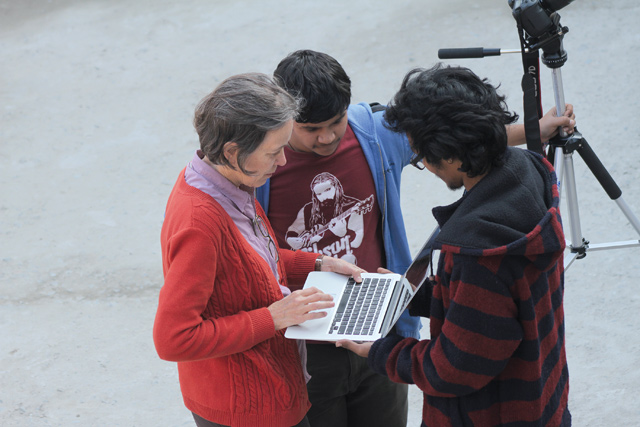
In 2014, Sanquini completed a film about five community schools that had been made earthquake-safe. She and Thapaliya had worked with a group of film students from Kathmandu University to produce what they hoped would be a video to test a theory on how people can be motivated to prepare for disasters.
The 20-minute documentary demonstrated how school communities and property owners could learn about earthquake-resistant construction. It was tested among 800 teachers, parents and alumni from 16 schools in Kathmandu Valley.
The research indicated that the film increased belief among viewers that it is possible to make a new building earthquake-resistant, and even to retrofit an old one. It increased their knowledge of specific earthquake-resistant design, materials and methods. It also increased their intent to support a safe-school-building project and to recommend the construction of earthquake-resistant homes to others.