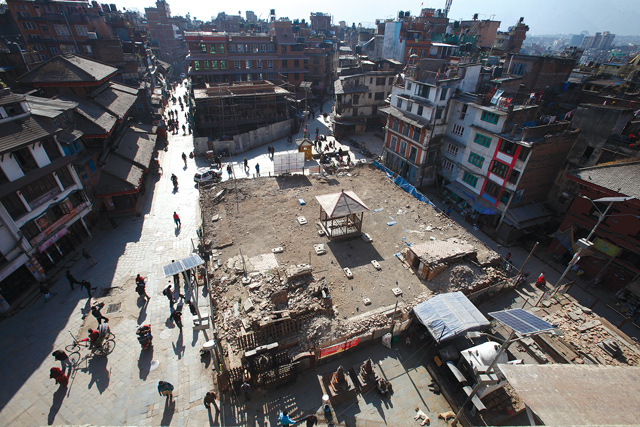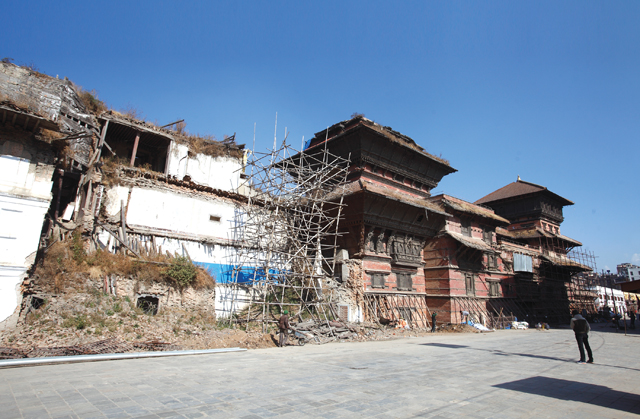
When the April 2015 earthquake destroyed Kathmandu Valley’s centuries-old monuments in a matter of seconds, it was the community that responded first to the disaster.
Neighbourhood groups were first on the scene, and after rescuing those trapped under the rubble they started the painstaking work of rescuing heritage items from the ruins.
This spontaneous reaction was possible because of the activism of the ancient guthi community trust system. Despite many areas in the Kathmandu Valley losing their homogeneity, the aftermath of the earthquake was proof that a sense of responsibility and ownership has survived.
But with the government’s decision to rebuild heritage sites through a laborious tender process, local community members worry whether that reconstruction will adhere to traditional architectural norms, and erode the sense of community.
“By calling out tenders for heritage reconstruction, the government is driving a wedge between the physical heritage and the people,” says conservation activist Sumana Shrestha. “Will future generations still feel the same level of love and ownership towards our heritage if the approach is not participatory?”
Many of the monuments that were damaged during the earthquake were intricately decorated brick and timber structures built in traditional Newari style that developed in the Kathmandu Valley over the past millennium.
Descendents of the original artisans who worked on the monuments can still be found continuing traditional crafts like woodcarving, stone sculpturing and metal works, and many say that not including them in the reconstruction process will be a blunder.
Observers say that proper detailed research on collapsed and damaged heritage sites is necessary before rebuilding and retrofitting. Recent excavations at the site of Kasthamandap showed that the foundation of the collapsed rest-house was intact, confirming that it was the structure above the ground that caused it to collapse.
“The lack of understanding of traditional structures is alarming. We don’t have structural engineers with proper knowledge of traditional structures,” says conservation architect Kai Weise.
Last year, the DoA came up with guidelines for the conservation and reconstruction of heritage damaged by the earthquake which ensures the local community’s participation when dealing with heritage. But so far that is just a good thought.
On the other hand, the DoA’s rebuilding efforts are being delayed by an ongoing debate between purists who attempt to adhere to traditional building techniques and others who say concealed structural elements embedded with sensitivity in reconstruction would be the way to go.