For the past six decades, Edmund Hillary has been a constant source of inspiration for mountaineers around the world. But he has also shown them why it is important to look beyond their expeditions and help people of the mountains. The schools, clinics, and airstrips that Hillary built in the Khumbu and his conservation initiatives have helped Nepal enormously.
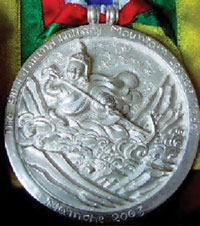
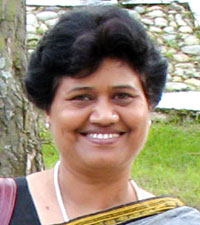
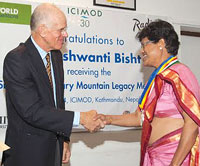
Mountaineer, conservationist, and economics professor Harshwanti Bisht was inspired by Hillary and it was fitting that she was awarded the Sir Edmund Hillary Mountain Legacy Medal on Monday for her work in protecting the Garhwal Himalaya in Uttarakhand, the Indian state bordering Nepal.Hillary’s son Peter, also a mountaineer, conferred Bisht her medal at ICIMOD (International Centre for Integrated Mountain Development) in Kathmandu.
In 1981, Bisht along with Rekha Sharma and Chandra Prabha Aitwal were the first women mountaineers to summit Nanda Devi (7,816m) in the Kumaon Himalayas. Three years later, she was part of the Indian expedition to Mt Everest. But Bisht was not satisfied with simply conquering the highest peak in the world.
“When I was in the Khumbu in 1984, I saw how Sir Edmund Hillary’s work to conserve the natural environment and to bring economic opportunities had improved the lives of the Sherpas,” she recalls. “After returning home, I also felt like I had to do something for the people of the Garhwal Himalaya.”
In the last three decades, Bisht has helped restore the birch forests around the sacred Gomukh temple at the snout of the Gangotri Glacier to stabilise the moraines of the receding glacier at headwaters of the Ganga. She has organised eco-awareness campaigns, propagated endangered medicinal herbs, and introduced ecotourism values in an area that has been ravaged by unregulated tourism.