
Ever since the brief but fierce war between India and China in 1962, the world’s two most populous countries have observed an uneasy truce, keeping their border dispute in a deep freeze. The Himalaya is hotting up 55 years later, and the cause is not just global warming.
When they met in Beijing in 1988, Deng Xiaoping and Rajiv Gandhi had an unwritten understanding to let the 3,000km Himalayan arc separate their spheres of influence. This pact has withstood numerous skirmishes along disputed borders in Arunachal, Ladakh and Bhutan, the Dalai Lama’s presence in India, and the lingering distrust between the two nuclear nations. Until now.
There are now geo-strategic rumblings along the Sino-Indian Himalayan border. China feels increasingly encircled, relations with Burma and Singapore have soured somewhat, and there is volatility in the Korean Peninsula and the South China Sea.
Beijing and New Delhi used to go out of their way not to irritate each other, but lately they are doing just the opposite. China has been preparing carefully for the post-Dalai Lama era, and could feel it expedient to keep the pot boiling on Tibet. Modi’s India could feel the need to perform an occasional war dance for domestic purposes.
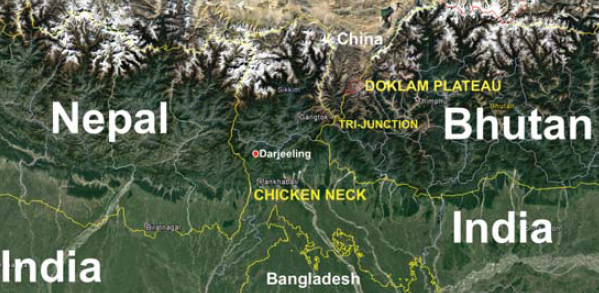
It is mystifying why the latest flashpoint had to be the disputed Doklam Plateau near the Bhutan-China-India tri-junction in the Chumbi Valley, which itself is astride India’s strategic Chicken Neck corridor. The timing of this flareup just 100km away from a violent statehood agitation in Darjeeling is also intriguing (See page 4-5). All this is a rude awakening for happy little Bhutan, the only neighbouring country with which Beijing has no diplomatic ties.