
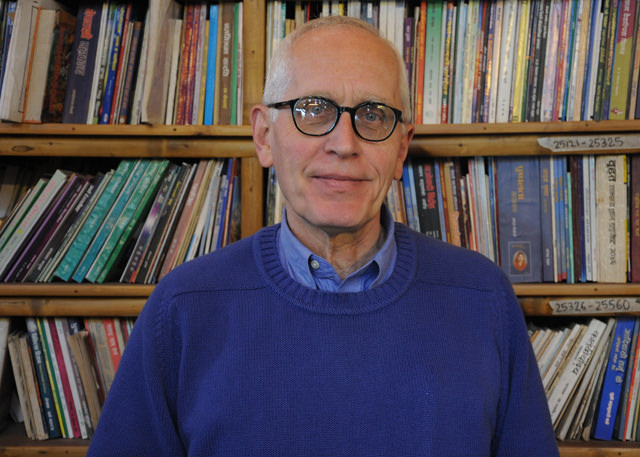
James Nye is a Bibliographer for Southern Asia at Joseph Regenstein Library at the University of Chicago and is an authority on archiving in the region. Nepali Times caught up with him during a visit to Kathmandu this month.
Nepali Times: What is the single most important change that has taken place in archiving in South Asia in the last four decades?
James Nye: Without a doubt, it has been the rise of collaboration between institutions for archiving, collection development, and preservation of resources. Almost everything that is important for the future will build on the solid foundations already in place and will benefit from expansion of our collaborative programs in Nepal and elsewhere in South Asia.
Some types of institutions are more suited to joining in collaborations than others. Within South Asia and also in Europe we have found that non-governmental organisations and private collections have been much better partners than government institutions. Our collaboration with Madan Puraskar Pustakalaya (MPP) in Nepal is a fine example of impact -- we have worked together in microfilming rare Nepali resources through the South Asia Microform Project, ensuring that periodical publications in the Nepali language are preserved and made accessible for use by researchers. More recently, MPP has been wonderfully successful in continuing programs funded by several grants from the Endangered Archives Program at the British Library.
What are the advantages and challenges of digital technology in archiving?
The Endangered Archives Program is an excellent example of how large audiences of readers around the world can benefit from easy access to rare archival resources in digital form. At the same time, some readers need to use original resources like paper manuscripts, printed books, photographic negatives, gramophone records, and other such objects. Some scholars studying the history of the book benefit from examining the paper used in printing and the watermarks on the paper as evidence for book production. Digital copies are not adequate to meet those special needs.
Has there been any effort to assess Nepal-related collections, say, across libraries and archives in the US?
Three decades ago North American research collections participated in a program called the Research Libraries Group Conspectus, created to provide a uniform evaluation of collections in all disciplines and from all geographic regions. The University of Chicago declared our Nepali collection to be at the research level. That is, we collect major published source materials, including all important reference works and a wide selection of specialised monographs, as well as maintaining an extensive collection of journals. A few other US libraries like Cornell University also described their collection on Nepal in similar terms.