 Read also:
- Switched on, Om Astha Rai
- Power Struggle, Editorial
- Mustering up energy to face the future, Om Astha Rai
- Future power house of South Asia, Sujit Acharya
- Kickstarting solar projects, Avishek Malla
- Private sector lead in solar grid system
Just as awareness about building seismic-resistant homes lasted only a few months after last year’s earthquakes, the public demand for electric vehicles that soared during the Indian Blockade appears to have tapered off.
Kathmandu’s traffic jams are as bad as ever, the import of petroleum products for the ever-growing numbers of diesel buses, trucks, petrol-driven cars and motorcycles have soared.
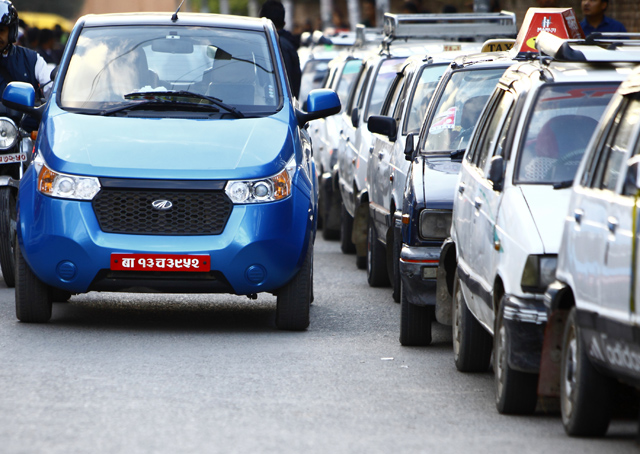
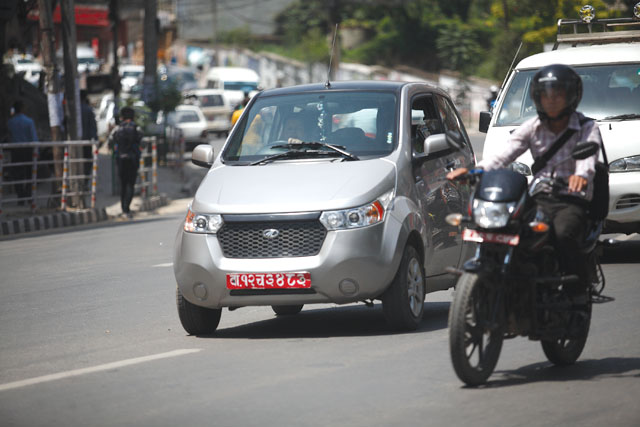
“It seems the public has a very short term memory,” says Cabinet Shrestha of Agni Incorporated, which sells the Mahindra e2O battery cars in Nepal (pictured). Sales doubled during the blockade, but interest has now waned.
High taxes on electric vehicles still put them out of the range of most potential buyers. And while Nepal has a long history of electric public transport with the first ropeway connecting Kathmandu to the plains installed 85 years ago, and upgraded in the 1970s. An electric trolley bus line connected Kathmandu to Bhaktapur. None of these are operational today.
“They were hugely successful until shut down, and they go to prove that electric transportation is feasible in Nepal,” said Bhushan Tuladhar of UN-Habitat.
The Ministry of Physical Infrastructure and Transport had drafted an Environment-friendly Vehicle and Transport Policy, but its guidelines have not been implemented. Some experts hint darkly at the powerful groups lobbying the government to prevent tax rebates and subsidies for electric vehicles in the coming budget.
What is proven is that except for a provision two years ago to cut excise tax on electric cars by half, and the waiver of road tax, successive government haven’t shown the political will to make an aggressive push to cut petroleum demand by introducing electric transport.
“To raise demand, petroleum has to be less attractive,” said Tuladhar. He said increasing petrol prices and ploughing the revenue into development of electric transportation market could be a win-win.
With recent innovation in lithium-ion batteries, electric vehicles have now become the rage with most mainstream manufacturers like Nissan, Chevrolet, Toyota and Honda entering the market with affordable e-vehicles. But the lack of incentives in Nepal has kept sales stagnant.