
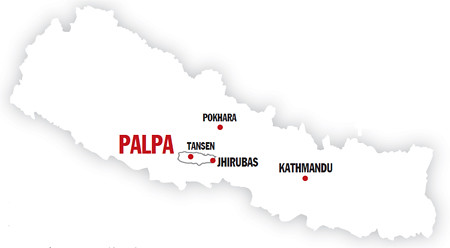
A wrenching seven hour ride from Tansen, the region’s Magar culture has been protected till now because of its remoteness: the language, dress, architecture, farming methods, and food.
The Thakuri residents speak Magar more fluently than Nepali and the men and women converse across ethnic lines in the local lingua franca as they settle down for chyang in the evenings. Magars have married Thakuris and vice versa.
If Jhirubas was Nepal, the harmony and co-existence here would give us all hope for the country’s peaceful future. Magar, Thakuri, and Dalit farmers all trade farm produce among themselves and with their Brahmin and Newar neighbours.
The road has now arrived in Jhirubas and with it has come change. There are now Christian churches next to Hindu shrines and Buddhist prayer flags. The children go to school where they learn in Nepali and not Magar, their mother-tongue.
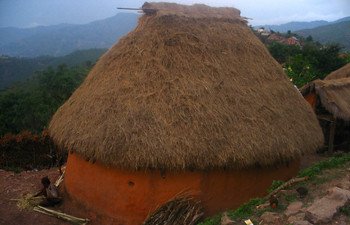
There is great hope that the road will open access to markets for local produce and bring down the price of food and other essentials. There is also potential for tourism: a chance for visitors to trek or bike to an area of Nepal which is still the way Nepal used to be with its quaintly cylindrical red mud houses with thatch roofs. Magar culture could be a draw, since the traditional farming lifestyle is largely intact.
This region of central Nepal used to depend almost solely on the money sent home by men working in India. But Jhirubas now has another claim to fame: it is a showcase of how community leasehold forestry can alleviate poverty.
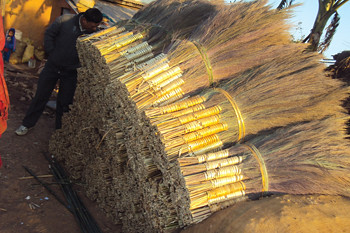
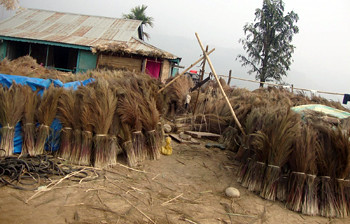
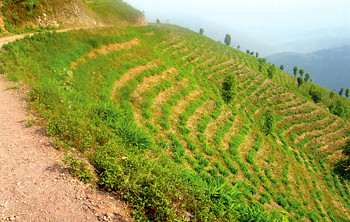
With help from the District Forest Office, villagers have converted degraded pastures into plantations of grass used for commercial broom-making. In just three short years, Jhirubas is where the country’s largest broom farm is located. With support from the Nepali and Finnish governments along with the UN’s Food and Agriculture Organisation, the farm has become a model for other villages on how to turn leasehold land into a sustainable income generator.
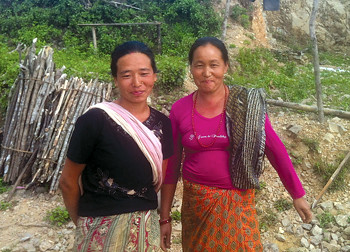
Since it was set up three years ago, the 227 households have supplemented their income by producing 3.3 million grass brooms to be sold across Nepal.
“We believe in working and not talking,” says Narayan Thapa Magar, who explains that staying away from politics has unified the people. That is also why the corrosive identity politics found elsewhere in Nepal hasn’t taken hold here and in fact locals get irked when the subject is brought up.
“Identity is important, but let’s not politicise it and divide up the country,” says Bir Bahadur Pata, “we did not prosper here because of our identity, but because of our hard work.”
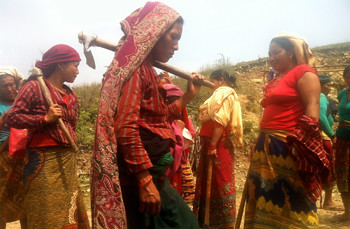
Next morning, the children are awake at dawn helping around the household before going off to school. Everyone is busy from dawn till dusk. The men work on the road, women on farms while their children are down at the village school.
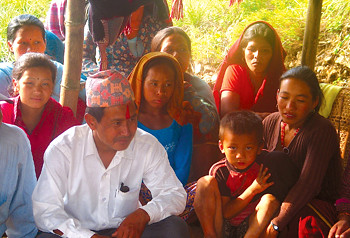
Others nod their heads, murmuring that they can see through the lies and games politicians play. “We have our own resources here and share it equally among ourselves,” says Hasti Maya Beyambu, who leads the local forestry user group.
When the subject drifts to local elections, there isn’t much enthusiasm. “If politicians want to win, they better start convincing us why we should vote for them,” says Mukta Bahadur Singh.
Bir Bahadur Patta, who has been listening intently, chips in: “But if any politician comes here to play ethnic politics, we will chase them out.”
Off road
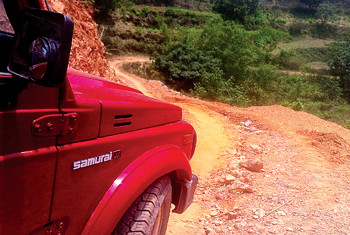
This stretch of road leads to the remotest corners of Palpa and is carved out of sheer cliff sides by Magar villagers who seem to have put their traditional quarrying skills to good use.
From time to time, the road is not just dangerously steep, it is also so tilted to one side you can see through the side window into the valley below. If this is how difficult it is to drive here in the dry season, imagine what it will be like when the monsoon arrives next month.
On the map, the road is officially designated as ‘motorable’ and that is a euphemism in Nepal for those suicidal enough to test their off-road driving skills. There is little time to admire the breathtaking beauty of this rugged land.
On the road from Tansen to Siluwa few have heard of Jhirubas. Locals who ride motorcycles up and down these roads were not sure whether this Suzuki Samurai could make it.
“Test it and see,” said one district forest official who said he had fallen off many times from his motorcycle, “find out if your car can make it and let us know.” So this is what being a guinea pig feels like.
Thirty km from Tansen, the first road begins in Siluwa which is surprisingly full of Newars who were banished here from Bhaktapur in the 18th century and all have the surname, Shrestha. They are all farmers and, unlike Newars in Tansen, they all speak Newari. Even the Brahmins in Siluwa speak Newari.
It wasn’t before I nearly fell off the edge of the road that I wondered if I hadn’t let my adrenaline rush get the better of my common sense. The car banked on the tilted road and I had to lunge to the other side like on a boat to keep the its balance.
Locals are always more than glad to help, moving rocks or pushing the car when it stalled. No outsiders ever come here except forestry officials or evangelical groups.
After seven hours of this, I was finally in Palpa’s remotest village of Jhirubas on the border with Nawalparasi.
A villager welcomed me: “So you have proved it is possible to drive a car here. Now, you have to return the same way you came.”