
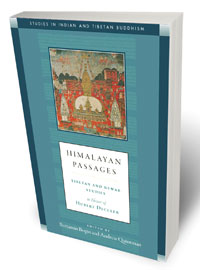
Himalayan Passages: Tibetan and Newar Studies in Honor of Hubert Decleer (Wisdom Publications), is a fine collection of scholarly, yet accessible, articles that should be on the reading list of anyone with an interest in the history, culture and religious traditions of this region.
Hubert Decleer, to whom it pays tribute, is a Belgian native who has made Nepal home since 1980. He is a well-known figure in the Kathmandu Valley, and one of its most renowned scholars and teachers.
As the founding director, then senior academic advisor, of the Tibetan Studies program at the School for International Training (SIT), he has been a beloved mentor to an entire generation of students, many of whom attribute their career choices to his benevolent influence. Several participants in his SIT programs went on themselves to become scholars in the field of Asian Studies.
Five of these experts contributed essays to this volume, including the editors: Benjamin Bogin, who teaches Asian Studies at Skidmore College, and Andrew Quintman, of Yale University’s Religious Studies department, who is a specialist in the traditions surrounding Milarepa, the Himalayan Buddhist saint.
The book grew out of the papers presented by a panel of Decleer’s former students at the 2010 meeting of the International Association of Tibetan Studies. In addition to their essays, it contains contributions from senior specialists in the various branches of Himalayan studies, including such notable figures as Ernst Steinkellner, Leonard van der Kuijp, Donald Lopez, Alexander von Rospatt, Anne Vergati, and Nepal’s own Punya Prasad Parajuli.
They cover an impressive range of topics in their articles, including religious and social history, sacred geography, art history, textual interpretation, and ritual studies. This is especially fitting in a tribute to Decleer, as they reflect the diverse areas in which he has done pioneering research. With a biography that includes time spent as a musician, artist, linguist and textual scholar, he has an expansive range of interests.
The articles are grouped under four overarching themes: Places and Pilgrimages, Texts and Manuscripts, Ritual and Visual Traditions, and Histories and Transmissions. While each of the 14 contributions represents first-rate scholarship, it is worth drawing attention to some of the essays, including those that might be of particular interest to local readers.