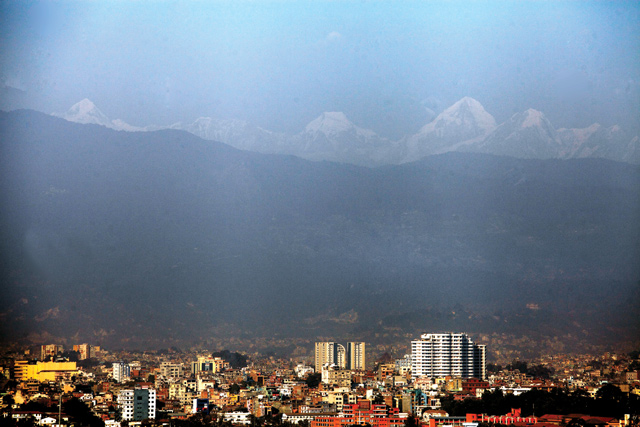
Everyone is selling, but no one is buying, or investing. That just about summarises the status of Nepal’s apartment industry.
Having suffered physical damage during last year’s earthquake, developers are struggling to assuage a wary public about the safety of their high-rises.
After the earthquake, not a single investor has sought permission to build new apartments in Kathmandu Valley. Those who had already obtained permits have postponed plans, others have cancelled projects. Those with damaged buildings have done patchwork repairs for their flats, but there are few takers.
“Builders have no confidence that they can sell apartments,” says an engineer at the Department of Urban Development and Building Construction (DUDBC), the government body that issues licenses for apartment construction.
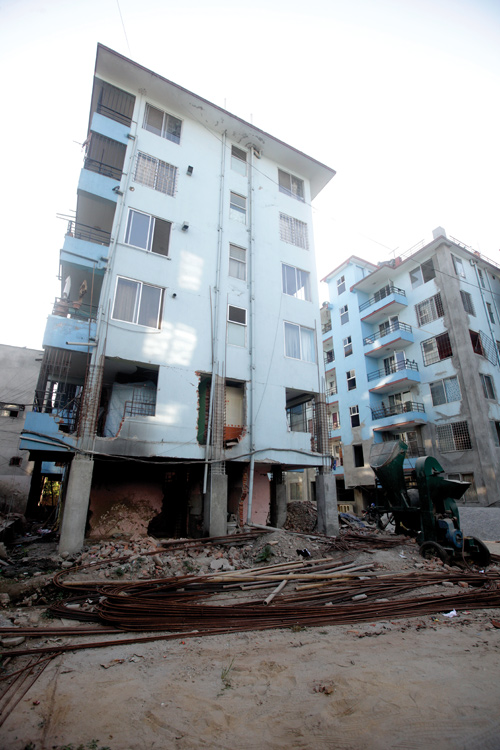
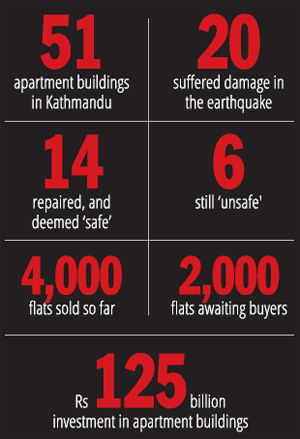
The DUDBC had issued the first license to build an apartment in Kathmandu in 2004 and until last year’s earthquake, the DUDBC had issued licenses for 71 apartment buildings. But only 51 were actually constructed. As many as 20 apartment buildings suffered cracks, and even structural damage. Of them, 14 were deemed ‘safe’ after being repaired, but six are still ‘unsafe’.
Six apartment buildings were under-construction, and investors have not shown urgency to complete these projects after the earthquake. Eco Housing and Realty Company had obtained permission to build a high-rise building with 108 flat units in Babar Mahal, but has shelved its project. Orchid Holdings has also cancelled its plan to build an apartment with 48 flat units in Rabi Bhawan.
At least 2,000 units are waiting buyers, and many families who left their damaged apartments after the earthquake are still scared to return there. Nepal Land and Housing Developers Association (NLHDA) says Rs 125 billion has been invested in Kathmandu’s apartments, and a large portion of this investment is now at risk.