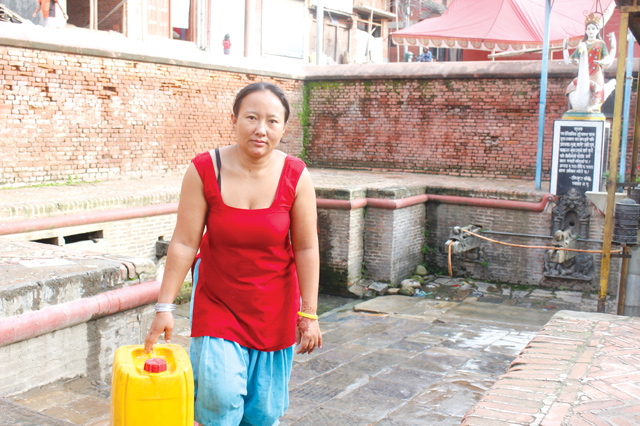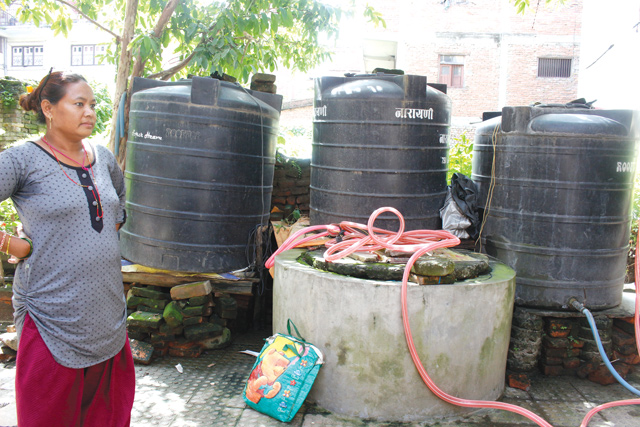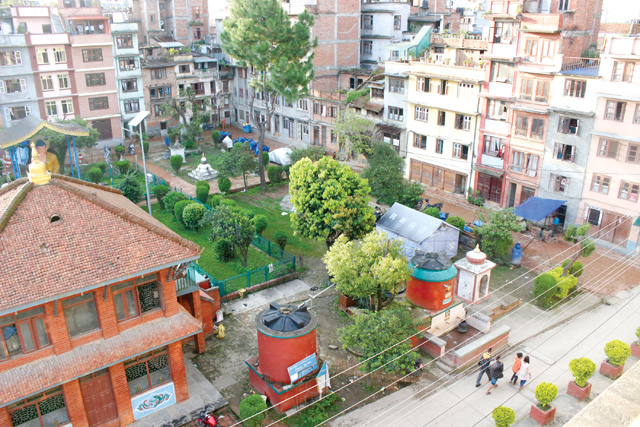
Kathmandu roads are being dug up to lay new mains to distribute water from Melamchi when it arrives, but access to it will reflect existing socio-economic inequities. The centre, as usual, will have priority over the periphery.
The first phase of the Melamchi Project will transfer 170 million litres per day (mld) through a 27-km tunnel to Sundarijal, then via a new distribution network and the existing pipeline to various parts of the Kathmandu Valley. But, daily demand in the valley is 360 mld, so there will not be enough water for everyone, and even those connected will only get four hours of water a day.
“If there was plenty of water for everyone, the distribution could have been uniform because the project has an improved network and delivery system,” says water expert Madhukar Upadhyaya. “But since the water will not be enough, I don’t doubt for a second that the usual water politics will come out in full force.”
Indeed, Melamchi may just repeat the findings of two recent PhD dissertations, one by Aditi Raina at the National University of Singapore, the other by Olivia C Molden of the University of Oregon: distribution will continue to favour richer households and those near main roads who already have greater access to government piped water. "Without adequately addressing water access issues for low-income families and renters, Melamchi will likely perpetuate existing social inequities in the city,” says Molden, a Fulbright scholar.
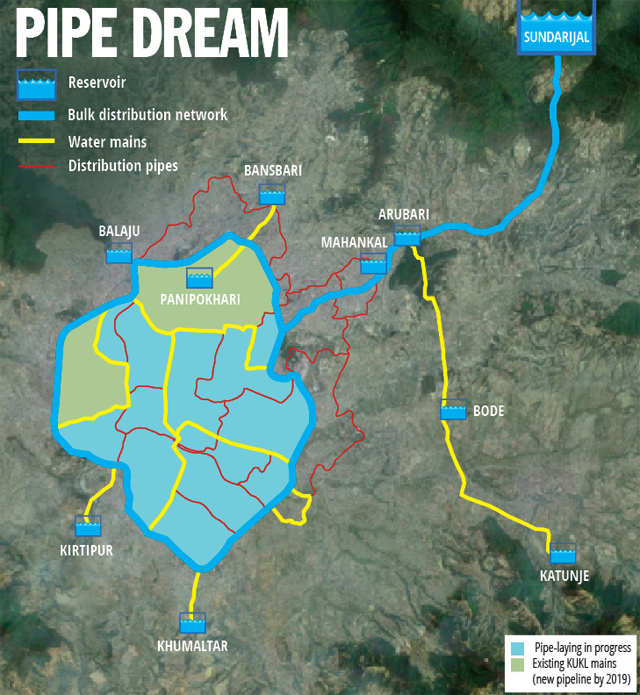
The distribution plan for the first phase of Melamchi water (see map) shows that areas inside the Ring Road, higher-income localities and those closer to the mains will get water first. The second phase will bring 340mld more water, but that may take another decade: by then Kathmandu Valley’s population will have exceeded 4 million.
At the Kathmandu Valley Water Supply Management Board, engineers say they are aware of the need for more equitable distribution, and plan to feed water to neglected neighbourhoods through reservoirs strategically located outside the Ring Road. “Uneven distribution was due to faulty engineering and haphazard planning in the past," (which meant, for example, that people who could afford it started using pumps to access more water), says Sanjeev Bikram Rana, an engineer at the Board. "The Melamchi pipeline has been designed to provide a minimum of 10m residual height, which means people won’t need water pumps. We will also have a scheme for poor households who use limited water.”
The water supply utility, KUKL, will introduce a computerised system to monitor and control distribution. This will end the existing practice of manually opening and closing water valves, which favoured well-off neighbourhoods that could afford the service.
670km of pipes have been laid so far, making the city look like a disaster zone this monsoon, but with 80% of the network completed, 40,000 houses are connected. Construction of five of the six new reservoirs, with a total capacity of 65,000 cubic metres, has been completed.
PID and the Department of Roads are temporarily repairing roads dug up during pipe laying. Once the system has been successfully tested, roads under the jurisdiction of the municipality will be permanently fixed.
"If water arrives in Sundarijal, we are ready to supply in October," says Tiresh Khatri, Chief of the Project Implementation Directorate (PID).
Yet, the project is unlikely to meet its October deadline because the final 2km of the tunnel has been delayed due to soft rock. Once the water finally arrives in Sundarijal, it will take six more months to test the flow and finish the treatment system. KUKL says it may be May 2018 by the time the first Kathmandu households get Melamchi water, which is snowmelt from the Langtang National Park.
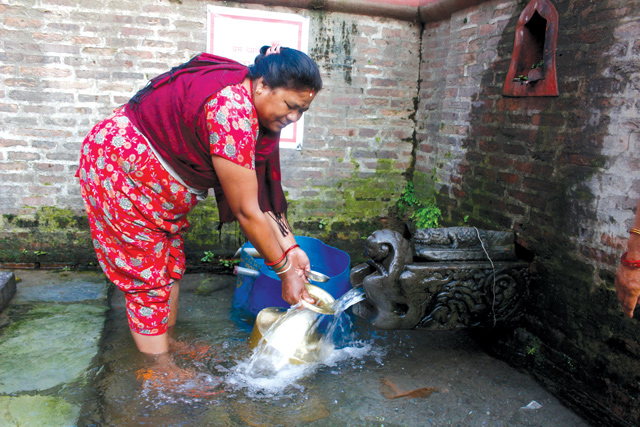
Kathmandu Metropolitan City architect Chandrashova Shakya says that Melamchi must be seen primarily as a solution for drinking water, and communities should continue with recharging Kathmandu’s ground water, harvesting rainwater and reviving traditional channels and water spouts for more sustainable use.
Adds Molden: “Alongside the modern pipe network, revitalising old water systems can provide additional public water sources that people can access for a variety of reasons."
The Melamchi water is estimated to cost Rs 400 per month for an average household. Experts hope putting a price-tag on the water will force people to be more prudent with water use so that treated drinking water is not wasted to flush toilets.
Madhukar Upadhyay concludes: “This is a hugely expensive project, and the water will have a cost, so we have to manage it locally, regard it as a precious commodity and not waste or misuse the water.”
Paying bills
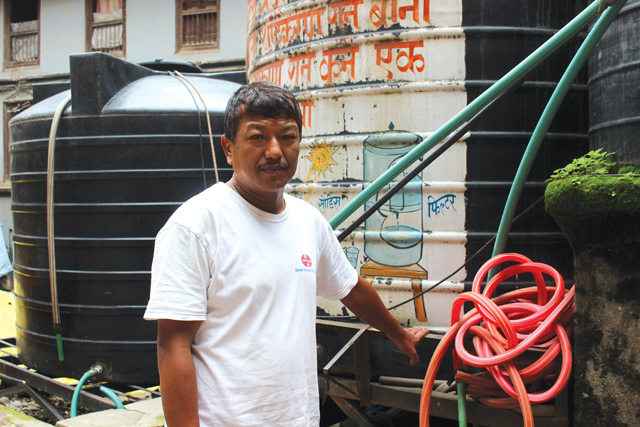
Many inner city residents of Patan have found that they cannot register to have a connection to new water mains unless they have cleared past water bills and fines. But some households are being billed for water they never got in past decades. Bhaikaji Maharjan and his neighbours in Lukhusi haven’t paid their water bills for years, and he doesn’t want to pay for something he never got. But Maharjan says some may be compelled to clear dues because of the promise of Melamchi water.