
As a result of the logistical bottleneck in relief efforts after last year’s earthquake, the Nepal Army is further upgrading its fleet with three new helicopters.
The Army added two Russian Mi-17 helicopters after the earthquake and now has three of this type, but its assortment of smaller helicopters comprises five different types and is difficult to maintain and operate.
Another lesson from the earthquake was that because the Army did not have its own lift capacity, it had to depend on foreign military helicopters, raising geopolitical sensitivities when Indian Air Force and US Marines choppers strayed too close to the Chinese border.
“It became really difficult for us to keep all sides happy,” admits one Army official. “If we had enough helicopters of our own we wouldn’t have been as exposed to such pressure.”
Currently the Army has three Mi-17s, two Bell 202s, one Alouette, two AS350 Écureuils and two Super Pumas. It also has Lancers, Cheetahs, and ALHs acquired during the war, which are all grounded.
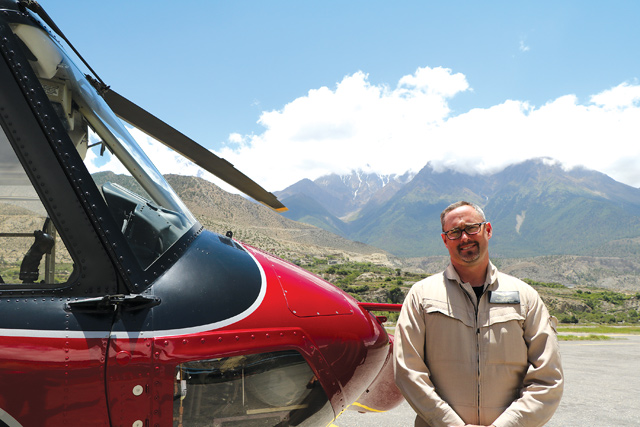
The Army is now looking at buying either the Bell 412 or AgustaWestland to replace the ageing VVIP Super Puma and two AS350 B3s. While the AS350s are proven in Nepal, especially for high-altitude rescue, the front runner is said to be the Bell 412 which conducted test flights at Mt Everest Base Camp and Jomsom last week.
“They were the most unique flights in my life, they were just wow!” said Bell test pilot Brent Berwick (pictured in Jomsom, above) who flew the 412 with Nepali helicopter pilots up to an altitude of 6,400m in the Khumbu and Annapurna areas. “I was really impressed with the outstanding airmanship of the Nepali pilots.”