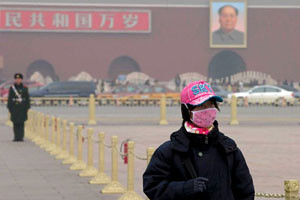
Forty-year-old Ali Akhtar never leaves home without what has become an essential accessory for most Nepalis: his brown cloth mask.
As the streets around his fabric shop in Jawalakhel are demolished for road widening and the neighbourood becomes shrouded in a cloud of yellow dust, Akhtar is trying his best to protect himself from the pollution and keep his business running.
While Beijing made headlines this week for the worst air quality on record (see box), Kathmandu Valley is not far behind. The average PM 10 count concentration in Kathmandu, a measure of particulate matter content in the air, was 183 ug/m3 in 2003 and 173 ug/m3 in 2007, both far above the WHO standard of 50 ug/m3 and the US National Ambient Air Quality Standard of 100 ug/m3.
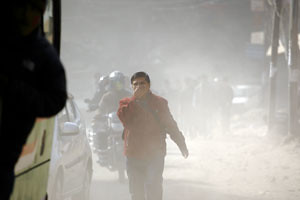
There is no data beyond 2007 because the seven monitoring devices installed by DANIDA across the Valley in 2002 to measure PM levels have been out of order for the past four years. Without the units, there is no mechanism to monitor and warn citizens to take extra precautions during bad days. The Department of Transportation, however, has said it is going to repair four of the stations by next month.
While mismanaged waste and unplanned urbanisation contribute to the city’s air pollution, vehicle exhaust and brick factories are the biggest polluters. Fumes from the 60,000 plus vehicles plying on the choked roads of the Valley add the most toxins. The road expansion drive has only made things worse.
Anjila Manandhar from Clean Air Network Nepal says that instead of improving air quality, the government has aggravated the problem: “They just tore down houses and roads, nobody thought about how to get the job done with the least amount of pollution and there were no cleanup efforts either.”
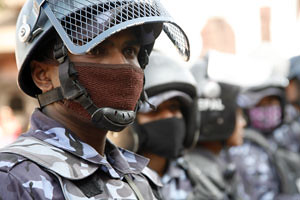
In winter, the Valley’s topography creates a cold inversion layer that traps warm and polluted surface air, trapping dust and smog. “Air pollution has become a huge problem and it gets worse during the winter,” says Buddha Basnyat, a doctor at Patan Hospital, “we have long queues and ward full of patients with respiratory problems at this time of the year and children suffering from asthma are also on the rise.”
Every year the government spends more than $ 21 million in medical bills for pollution related illnesses. Street vendors, construction workers, road workers, and traffic police who are exposed the longest to the smoke and dust face the greatest risk along with those who attend schools, colleges, and offices located along major roads.
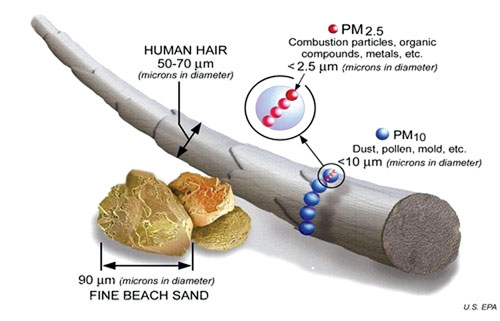
According to a recent study conducted by the Nepal Health Research Council the average PM 2.5 (the smallest pollution particles) around a school in Jawalakhel located next to the road was 200 ug/m3, significantly higher than the WHO threshold, and the national standard of 40 ug/m3.
Arjun Karki, a pulmonologist at Patan Hospital, says pollution is not only harmful in terms of health, but stunts the country’s economic growth. “When an adult falls sick, the family risks losing its source of income, productivity goes down, expenses go up and sometimes the family is pushed into poverty,” explains Karki. Streetfront shops like Akhtar’s lose business when pollution is higher.
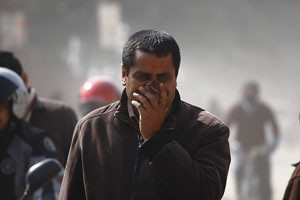
While the road widening campaign is partly to blame for the thick clouds of brown dust in Kathmandu, lack of government control and monitoring is also responsible. The state introduced a Vehicle Emission Standards (VES) test in 1995, and those four wheelers which passed were given green stickers. Similarly the ban on vehicles older than 20 years was announced in 2000.
However, many government vehicles don’t have stickers and not all those that do have actually passed the test. Corruption is rife and the traffic police hardly checks the validity period. And despite repeated attempts to stop the worst offenders, the state hasn’t been able to enforce the ban on old vehicles plying on the roads of Kathmandu.