
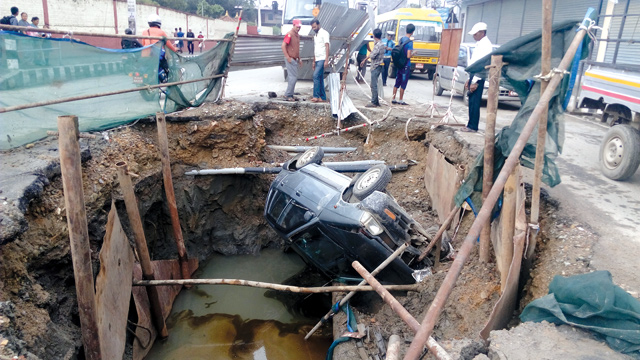
It took the death of a school girl and a scary viral video of another girl falling into an overflowing drain for Prime Minister Sher Bahadur Deuba to see pits and potholes on the streets of Kathmandu.
After a downpour last Friday, most of Kathmandu's streets were flooded and 10-year-old Binita Phunyal failed to see a drain deluged with water. She fell into it, was swept away and died. The same day, 13-year-old Satya Sapkota was sucked into a whirlpool that formed inside a cesspit, but was rescued alive. Her near death was captured in a mobile video, which went viral on social media.
The next day, PM Deuba directed top authorities to work day and night to fill all holes on Kathmandu’s streets within 15 days. But there are too many pits, potholes and even sinkholes to be filled in such a short time.
In the wee hours of Thursday, a car plunged into a sinkhole in Maharajganj, leaving three injured. Early in the week, a buffalo fell into another sinkhole in Chabahil, and needed to be pulled out with a crane. Last month, three construction workers died after falling into a trench they dug to lay water mains for the Melamchi project.
Years of political instability, lack of accountability and a sluggish bureaucracy have rendered the Kathmandu Valley virtually unliveable, and an order by the PM will not transform the city overnight.
If anyone can improve the city (not just Kathmandu), it is a mayor and his/her team of elected representatives. The Constitution that PM Deuba and Maoist Chair Pushpa Kamal Dahal are trying to amend in order to appease Tarai-centric parties has given newly elected mayors and village council chiefs unprecedented power and autonomy.
But four draft bills on local governance and inter-governmental fiscal transfer have threatened to weaken self-governing local councils by robbing them of their constitutional rights to mobilise local resources.