
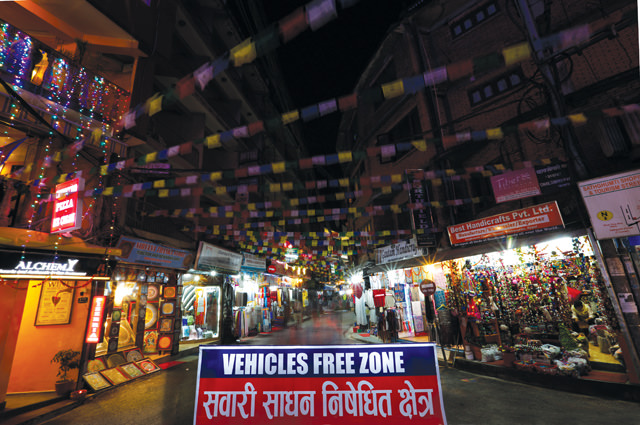
Winter-like weather has come early to Kathmandu Valley this year, and with it the temperature inversion layer that traps pollution. Already in early October, visibility has been so poor that there are massive delays in flights in and out of Kathmandu airport. Suspended dust particles from unfinished road work, increased emissions from the growing number of vehicles and brick kiln emissions in Kathmandu have added to trans-boundary pollution from crop fires and soot particles blown in from northern India by prevailing winds.
Read also:
#BreatheFree, Ayesha Shakya
A study by the Energy Policy Institute at the University of Chicago last week added proof about how air pollution is shortening the lifespan of people in Asian cities with the dirtiest air. Given that Kathmandu Valley’s air quality is even worse than in New Delhi and Beijing on most winter mornings, this should be cause for grave concern. Residents of Kathmandu, the Tarai and Chitwan could have their lives shortened by as much as four years because of foul air.
In an online survey by Code for Nepal, more than three-quarters of respondents said Kathmandu’s air quality was undermining their health. In written suggestions and responses, some actually said their decision to emigrate abroad was prompted by deteriorating air quality.
Last winter, there was unprecedented public outrage as pollution levels stayed at dangerously high levels for weeks on end. The reason was dust particles from road expansion and building reconstruction. Dust was visible, but the really dangerous pollution was from diesel fumes. In one year, the number of vehicles in Kathmandu has grown from 923,000 to 1,042,000, meaning that this year the concentration of toxic emissions will be even worse.