
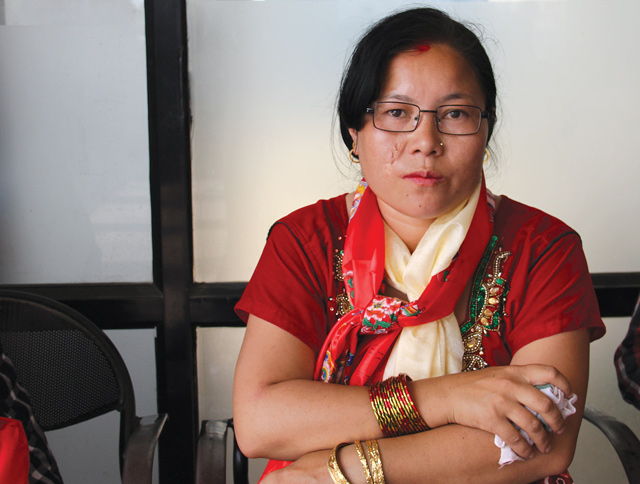
TAKING LEAVE: Dhanmaya Tamang at Kathmandu Airport before boarding a flight for Muscat last week. She had planned to quit her job and return to Nepal to be with her children, but with her house in Kavre destroyed by the earthquake, she is going back to Oman. Photo: Karma Dolma Gurung
Dhanmaya Tamang, a mother of two, lived the perfect Nepali migrant dream in Oman.
She worked as a janitor in a hospital, and her husband was a waiter in a restaurant in Muscat. Their two children studied in a private English school in Kathmandu. From the savings of their two years of hard work the family had built a house in Kavre. When neighbours sent her pictures of their collapsed house, Tamang fainted with shock. She couldn’t sleep or eat for two days, and was admitted into the emergency ward of her hospital.
Finally, her employers were convinced about the seriousness of her loss and allowed her a month’s leave. To save unnecessary expenses, Tamang left her husband in Oman and travelled alone to Kathmandu.
“By the time I reached my house, everything was gone. I couldn’t even find a tea cup left. Whatever was left the villagers had already taken it,” she said.
It has been a month since she came to Nepal, and Tamang says she can’t stay in Nepal anymore. “I need to go back and earn more money to rebuild our house. My husband has no education, so I have to also work to support him,” she added, as she prepared to board her flight at Kathmandu Airport last week.
Migration experts say that there is a surge in outmigration for work after every major disaster like the Asian tsunami of 2004 or the Kashmir earthquake 2005, and the same seems to be happening in Nepal. However, even at the best of times female migrant workers are more vulnerable to exploitation and abuse.
“There is a global trend in the aftermath of disasters amongst women for unsafe overseas migration as well as internal displacement,” said Saru Joshi of UN Women in Kathmandu. Few women have official labour permits since female migration is still banned to some Gulf countries, and there isn’t reliable data about how many women are abroad.