
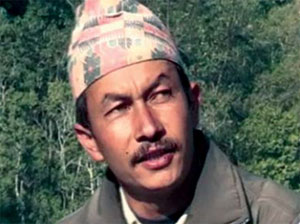
In June 2004, the Maoists blocked the pipe that brought water to the district capital, and Dekendra Thapa and other journalists walked to the Maoist-controlled area to try to persuade them to open it. Instead, they were kidnapped by the rebels, and while the others were released, Dekendra was detained.
A month later, eyewitness reports started coming in about the Maoists torturing him by hanging him upside down and beating him until he died. The Maoists put up posters claiming responsibility for killing him. Dekendra’a wife Laxmi lobbied hard and got forensic experts to find and exhume his body after the conflict ended in 2006. When they found the body, his mouth was wide open, his left leg and right elbow were broken. He had been buried alive.
Fast forward to 2012: police inspector Binod Sharma had kept the investigation open and finally arrested four of those accused of Dekendra’s torture and murder. One of them was Lachhiram Gharti, who confessed to the torture and asked to be detained because he was wracked by guilt.
By this time, Maoist ideologue Baburam Bhattarai had become prime minister in Kathmandu, and got his handpicked Attorney General Mukti Pradhan to call off the investigation. Prosecuting the guilty would have set a precedent for the investigation of other war crimes. Senior Maoists leaders are implicated in other cases, including the torture and murder of Krishna Adhikari, whose parents are on an extended hunger strike in Kathmandu.
Back in Dailekh, key witnesses in the prosecution of Dekendra’s killers have all retracted their testimonies one by one. Chandra Bahadur Gharti had told investigators that on 11 August 2004, he and Man Bahadur Sunparai heard screaming at the Nepal Rastriya Primary School and went to find out what was happening. “We saw Lachhiram Gharti and eight others beating journalist Dekendra Thapa with sticks. When Dekendra couldn’t speak anymore, we saw them drag him to Lachhiram’s house,” reads Gharti’s testimony.
However, recently Chandra Bahadur Gharti made the following deposition at the District Court: “I was away working in India when the event happened, and returned only four or five months later. I don’t know who killed Dekendra, where or how.” Another witness, Amrita Sunakhari, had told the same investigator: “A Maoist named Bam Bahadur Khadka alias Mukti, Lachhiram and others had kidnapped journalist Dekendra Thapa and kept him in our house. After questioning, they took him towards Dwari, and I later heard that they killed and buried him.” But Sunakhari withdrew her statement and told the court recently: “I don’t know Dekendra Raj Thapa, I don’t know where, when and how his death occurred. I don’t know if the accused killed him, the accused should not be punished.”