
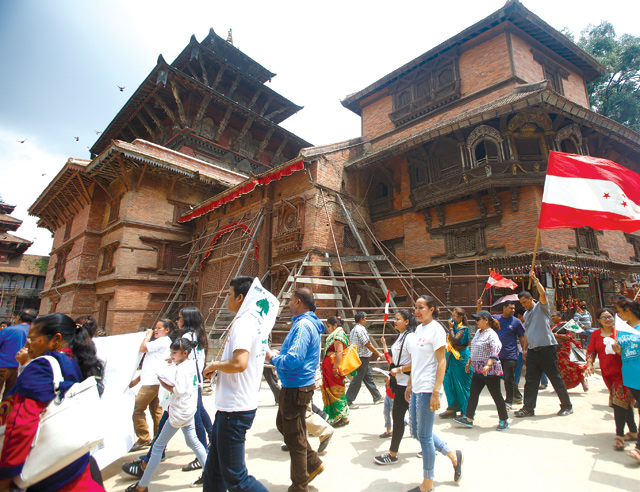
When new mayors and village council chiefs assume office after the first round of elections on 14 May, they will confront a citizenry with very high expectations of good governance and development.
These are the first elections to local councils since 1997, and people are desperately waiting for their chosen representatives to make up for two lost decades. But newly-elected ward, village and municipal council members and mayors will face multiple challenges trying to solve long-neglected problems. Voters will be impatient, and the parties may not be able to make a difference right away.
Read also:
Nationally local, Editorial
Resuscitating democracy, Guest Editorial
Electing for a better future, Kunda Dixit
To start with, most new village and municipal councils will not even have desks and chairs. They will have to work out of what used to be VDC buildings, which will have to be converted into ward offices.
“The first round of elections is taking place where earthquake survivors are living in temporary shelters,” says Krishna Prasad Sapkota, ex-president of the Association of District Development Committees Nepal. “And in most of these villages, the newly-elected local council chiefs will also have to work out of temporary shelters.”
The 744 new municipal and village councils will have many more powers and will need at least 70 staff each, up from the present 10. The Ministry of Federal Affairs and Local Development is working to transfer former VDC and DDC staff to the new local councils, but this is not going to happen even by the time the next round of local elections are held on 14 June.
Damodar Rijal of the Association of VDC Secretaries says most councils will need more than 70 employees: “If a village council is to perform all its tasks, it needs at least 150 employees, so our new representatives will have neither proper offices nor sufficient staff to deliver services.”
The Constitution has given municipal and village councils 22 exclusive rights to draft their own laws, hear legal cases, collect taxes and issue licenses for new schools and radio stations. Former municipalities and VDCs were local administrative units, the new units will be real local governments with the powers of the executive, legislative and judiciary rolled into one.
“Greater responsibilities mean greater challenges,” says Ghanshyam Khatiwada of the National Association of VDCs. “If newly-elected representatives are not trained to understand their roles and perform their duties, they will be lost.” These logistic shortcomings, however, pale in comparison to the challenges newly-elected local bodies will face from the feudal hierarchies within their own parties, who will want to centralise decision-making.
“The political parties that are at the centre are not willing to devolve power,” says Mukti Rijal, an expert on political decentralisation. “They tried their best to prevent local elections, and will grab every opportunity to prevent real devolution.”