

At 73, Ambar Gurung is frail. He needs help to walk. But there is a twinkle in his eyes, his heart still beats with the same  deep love for the Nepali nation that stirred us all once with the song, ‘Naulakha tara’ and most recently with the country’s new national anthem.
Here in Nepalganj this week, Ambar Dai ends his Paleti concert with ‘Naulakha tara’. His voice frays when he gets to the part ‘…niyali hera hamilai bhijeko chhaina parela’, but you can still detect the soothing texture of a famous voice that is unmistakably Ambar Gurung's. The haunting words take us all back to an era of innocent national pride, of diasporic longing for the motherland, and a time when life was simpler and violence hadn’t torn the country apart.
Two emotions bring tears to Ambar Gurung’s eyes. One is the memory of youth and of friends who have passed on when young musicians break into Aruna Lama’s ‘Samalera rakha’ and ‘Pheri kali phulera’ whose lyrics he wrote 50 years ago. The other is the sorrow of war, and the fear of fragmentation of a nation - a nation he has devoted his life to uniting through music.
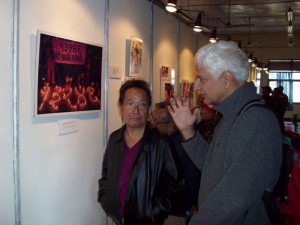 An emotional Ambar Gurung stops at the photograph of a peace vigil for the total number of Nepalis killed by Nepalis during the war during the exhibition of People After War in Nepalganj on Tuesday. PHOTO: ARPAN SHARMA
When he visited our People After War photo exhibition in Nepalganj earlier that day, Ambar Dai lingered over a photograph of a father being embraced by his daughter and son who were fighting on opposite sides during the war. The cover picture of People After War, taken by Charles Haviland shows Maoist guerrilla Juna Rai and the Army soldier Bhuban Rai reunited with their father at their home in Khotang after the war.
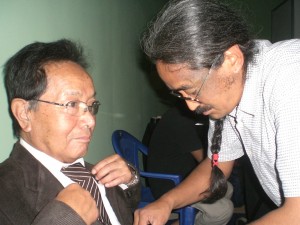 Singer Amrit Gurung fixes a tie on his guru, Ambar Dai, before the Nepalganj concert. PHOTO: KUNDA DIXIT
“Yo Nepali daju baini bich ko ladain rahechha. It was a war between Nepali brothers and sisters,” says Ambar Dai. He says he has been inspired to compose a piece dedicated to reconciliation between Nepalis. The man who put to music ‘Sayaun thunga phul ka hami’, the lyricist who has brought a strong sense of Nepali-ness through his songs, is aghast that politicians are only talking about dividing rather than uniting.
In the news broadcast from Kathmandu this morning, I listen to Pushpa Kamal Dahal giving a speech at a gathering of his supporters in which he says: “Only 10,000 died in the war, the next war will see one million dead, we will swim in blood.” They never learn.
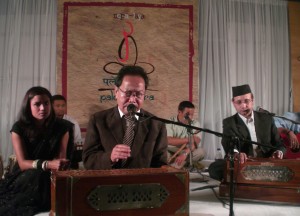 Gurung with Angela Singh and Avas on the Paleti stage on Tuesday. PHOTO: KUNDA DIXIT
That evening, Ambar Gurung begins the concert with his ‘Ma Ambar hun’, and then the soothing words and melody of ‘Ukali lagda pasina puchhne…’. His voice breaks, and he has to stop. His student, Avas, steps right in singing the missing stanzas.
Nepa-laya also timed the concert tour for Narayan Gopal’s 70th birth anniversary this week, and Ambar Gurung pays a tribute to the great singer with a rendition of his ‘Gham ko jhulka’ sung by Angela Singh. The female vocalist adds a delicate new dimension to Narayan Gopal’s trademark voice in that famous number, and sings Aruna Lama oldies with great sensitivity.
Ambar Dai lets Avas sing ‘Jasai kesh timile phukayau’ and smiles at the words written long ago about the simple sight of a woman’s hair flying in the breeze that makes him marvel at the joy of life: ’Jindagi hera muskurayo…’