Sabina Feb 16, 2010
No sir, we all have forgotten, how Maoists murdered the ordinary amongst us in cold blood. We have forgotten that these blood thirsty criminals do not deserve an inch of political space in our society. We have forgotten the world does not really need communists, especially the one that is a gang of murderers and looters. We have not just forgotten Gyanendra Khadka, we have cursed him by letting the Maoist criminals scot free in our society.
jange Feb 16, 2010
This is hardly news. The behaviour of the Maoists described in the article is entirely in keeping with their character, ideology and objectives. Is it news if a dog barks, a cow moos or a donkey brays? No. What is newsworthy is that papers like the NT regarded the Maoists and still regard them as agrapanthi, the only party representing change and so on. Plus the fact that political parties and the media still follow the agenda set by the Maoists when the real priorities of the Nation is different. I am not surprised that the killer holds a high post. If, according to the NT, the nation is supposed to be grateful for the political "achievements" of the Maoists, achieved on behalf of the whole nation, achieved by thousands of other similar killings then we should be appreciative that this person was killed; for without his killing we would not be enjoying these achievements.
hange Feb 16, 2010
And these are the people who are fighting for civilian supremacy? Chalking it up as an act of war would be a whitewash but why is it that even now the perpetrators walk free? Arthur, where is your support for the great bastion of change now? Is it on the side of the first khukri cut or the strike from behind that essentially beheaded this individual?
chandragurung Feb 16, 2010
Thanks for this note. Perhaps we have forgotten but we won't since every once in awhile someone will , like you, remind us that there had been a gross injustice in our society.
Dr Tom Marks Feb 16, 2010
Superb piece, noble gesture. More are needed just like it.
Satya Nepali Feb 16, 2010
Such murders didn't matter when the "Democratic" parties joined the blood-stained hands of the Maoists in Delhi. Mr. Dixit welcomed that as a "breakthrough". Such cold-blooded murders of ordinary people were forgotten when Maoist guerillas were red-carpeted into our cities and villages glorifying their "war" as a "struggle of the people", no less! Such murders were curtained up when Maoists were given one-third seats in parliament and their leaders, who presided over these murders, were made Ministers of the land. Mr. Dixit and the agra-panthi of Nepal cheered all these "developments" as the forward march to "Naya Nepal". Which corner of their consciences did the Dixits and other agra-panthis hide the memory of these Gyanendras and Muktinaths then? The Maoists' brutal murders were all kosher then. Or at least not bad enough to prevent their party from being "mainstreamed", legitimized and hurrahed into power without, let me emphasize, without any demand for an unqualified apology or disavowal of their violence. What's the point of re-visiting these murders in such gruesome detail now? Is Dixit trying to publicize his book and pictures? Or his own self as the great Samaritan who handed over 30,000 rupees to a tragically bereaved family? Or is it a veiled threat, a subtle blackmail message, if you like, to the Maoists? Better behave! Better not rock the boat "too much" or else look, we have all these stories of your gruesome atrocities bottled up in our archives! They say wine gets better with age. Is it the same with bloody murders, Mr. Dixit? If not, why this long delay? What's made you decide that all these gruesome murders that you bottled up and conveniently slept over all these years is now ripe enough for uncorking?
Sarath Feb 16, 2010
Thank you Kunda. This is what sets you apart from other armchair editors I guess.
Coming back to the topic, blood boils in my head when I think of certain NGO’s like Advocacy Forum who shout human rights at every opportunity, and their foreign masters who turn up in Kathmandu to lecture us after failing to get a job in investment banks in London and Wall Street. These well fed activists are hell bent on going after the army.
Look how Maina Sunar’s case, (very appalling I know) has been the biggest bread-earner for them all. Why don’t they lift a finger on the Maoists too? Maoists murdered so many of our teachers just like they murdered Gyanendra Khadka. Only some of these came to limelight. When I was in Jumla last year, I met a 70 year old man and his wife whose only son, a teacher, was killed by the Maoists in their front yard.
Look at the family now. Imagine if Gyanendra Khadka was still alive. They would be poor but they would be happy. I will never forgive these criminal Maoists for what they have done to thousands of our families.
sun Feb 16, 2010
there are many cases in nepal. this story is heart breaking and government should take care of moist victims. i still remember a brutal killing of teacher in Tanahu district who was a teacher too. may god help moist not to do anymore in future
bandhuraj Feb 16, 2010
We still remember who did it how it was done and where it was done. No one can erase the history. I am afread that the maoist are still making threat to repeat the history. I am still waiting for the day when Nepal can bring these Genocides under the "rule of law".
WhoIsHe Feb 16, 2010
"The killer is known. The mastermind of the murder is now a personal assistant to a senior Maoist leader."
I would sure would love to get more clarification on the statement above. May JUSTICE then be served as needed, by law hopefully or else by whatever means needed.
Ujjwal Acharya Feb 16, 2010
One of the horrible photos of the so-called people's war.
If we are hoping that such incident would not happen in future by any group, then we should ensure that the mastermind behind such inhuman acts get punished even when we are talking about the peace. Otherwise, every other political group, now or in future, go on murdering rampage of people they don't like.
Had Gyanendra, and other journalists killed in during the period, done anything wrong? Media should ask, until they get the answer, from the Maoists and the state!
Sunel Thapa Feb 17, 2010
Unfortunately, all those whose lives were taken brutally by the maoist today remains unheard of, but only those moaist who were killed were declared matrys and awarded 10 lakhs each, in addition the NC and UML followed the same suit and even awarded million of rupees to their cadres. Today all those 15,000 people who lost their lives for no reason are forgotten and those security forces who fought for the nation under the security mobilization act passed by then PM Girija Pd Koirala and Sher Bdr Deupa. It is such a joke to learn that Girija Pd Koirala is being nominated by Government of nepal for Nobel Peace prize and lavishing enjoying a lavsh perk of over Rupees 1 lakh per month from the state today.
Next revolution should be against the leaders of these parties.
jange Feb 17, 2010
If the killer is known, can the NT publish his name?
Subodh Feb 17, 2010
Vintage Kunda! We should not forget, even if we have to forgive.
Unknown Tamang Feb 17, 2010
How true this all may be, can we also read an article please in which Mr Dixit describes how (and how many) innnocent people were killed by Royal Nepal Army soldiers?
jange Feb 17, 2010
Well, so much for freedom of information and the right to know. If the author knows the name of the killer why can't we too?
Pacific.scoop.co.nz » Memories of a Nepali husband, father and martyred journalist Feb 17, 2010
[...] Kunda Dixit is the editor of the Nepali Times and author of several books, including the trilogy on the conflict in Nepal: A People War, Never Again and People After War. His blog is Eastwest. [...]
Sunil Feb 17, 2010
Gynandra Khadka was murdered in cold blood by the Maoists. Krishna Sen was murdered with no less brutality by the state. It would be nice if Kunda Dixit uncovers how Krishna Sen, another journalist , was murdered.
jange Feb 17, 2010
Why so shy about telling us who killed him. It is not as if it was a crime or anything to be ashamed of. It was done for the revolution, for the people, for the removal of a hated and despotic monarchy, for federalism. Look at what has been achieved. The Maoists should be proud of this fact. Whoever killed Gyanendra Khadka should be able to say, " I killed him. It was for a glorious cause, and I would do it again for it was on behalf of the people."
prakash koirala(sindhupalchok) Feb 17, 2010
Thanks,Kunda Dixit .
Budabaaje Feb 17, 2010
The elite power-brokers of Nepal are all about mincing words, hiding some information, releasing others and so forth to suit their own interests... this is just like Girija and Prachanda threatening to carry out a full investigation of the Palace Massacre but never doing it... it's all about threatening to release information to suit their own interests.
Back in 2005-06, these stories were suppressed and stories of Army atrocities and king's criticisms were emphasized. Maoists were cheered and glorified. Now that Maoists have served their purpose, it's their turn to face the music!
Ram Feb 17, 2010
I doubt Krishna Sen was murdered with "equal brutality". But yes, I would like to hear about it...
Nabina Feb 18, 2010
@ Sunil
Now here comes a Maoist criminal himself. You think Krishna Sen's thraot was slit tied to a pole, in front of his wife?
Why are these Maoists so annoying, dumb and pig headed anyway?
rishav Feb 18, 2010
I feel very sorry for the family and what they have to suffer through even now. unfortunately this isn't an unusual story but many deaths similar in style occurred during that period at the hands of the Maoists. There were murders committed by the army as well during their deployment but I don't remember murders of innocent civilians like this occurring by the army in any other time in Nepali history outside of the Maoist insurgency era. The Maoists in their quest for power, not accepting democracy, created a situation in which an armed rebel group and state went to war with the innocent people , stuck in between, the ultimate victims.
Tom O'Neill Feb 18, 2010
Thank you for this - I remember the horror at hearing this story and seeing this photograph years ago. How will there ever be lasting peace, unless these events are remembered and accounted for?
Bhallu Feb 18, 2010
"The mastermind of the murder is now a personal assistant to a senior Maoist leader." Afraid to name him as you may as well be crucified on a volleyball post? You journalists are still afraid of the Maoists, aren't you?
rishav Feb 18, 2010
I would like to add an article by Dr Thomas Marks (expert in counterinsurgency strategy)
http://www.nepalhorizons.com/beta/articles.php?newsid=347
Arthur if your reading this, see what a real analyst with credentials, experience and understanding of ground realities views the situation.
Tara Feb 18, 2010
This is a harsh reminder of what Maoists have done to this family and many more innocent Nepalis over the years. However, I would like tell something to the editor of "nepali TIMES". I do not think it is appropriate to post the picture of Late Khadka like that. I can't imagine a person of Mr. Dixit's stature would be unaware of the sensitivity of the type of the photo that has been posted there. How would the children and the family would feel when they see their loved ones such fateful picture over and over ? Publishing the news is certainly praiseworthy, but the picture should have not been put there in such a manner like he is nothing. This is such a disrespect to Late Gyanendra Khadka. Please take the photo off as soon possible.
Sunil Feb 18, 2010
@ Nabina,
Journalism is all about being impartial. You called me a criminal I, however would like to forgive you. I know you are in dark. you are well aware of Gynandra Khadka's internationally condemned murder but you have very less idea about how Krishna Sen was killed. Let me repeat my previous statement again, Krishna Sen was murdered with no less brutality.
Nabina I understand that it hurt you immensely seeing Gynandra Khadka killed in the most inhumane way. I was the same. The difference between you and me could be that only Gynandra's murder got you distressed. Remember that Sen was also in the same profession as Khadka was.
My urge here is lets be credible, impartial when we write pieces.
Bulbul Feb 18, 2010
This is only one out of thousands of such cases. If Gynandra Khadka's little son, when he grows up chooses to avenge his father's murderers, I will fully support him in hunting the criminals down. Too bad our corrupt, coward and good-for-nothing leaders have set him/them free - the boy should be allowed to seek justice -even if it means taking the law into his own hands.
Anonymous Feb 18, 2010
Finally, it needs a punch across the face to change mind! Thank god they spared you last year and now you have come back to senses. Weren't you the one among those supporting Maoists against the King? And see what state honour are they enjoying and ripping the country apart. Anyway I like to read your peices...
Anonymous Feb 19, 2010
That is a different anonymous, but could you kindly remove that picture, it is very very disturbing.
Nabina Feb 19, 2010
@ Sunil
Apologies, I didn't mean to label you a criminal, but your opinion is no less troubling than the mind of a criminal.
Of course Krishna Sen was killed in cold blood, but not with this level of barbarism and brutality. Laws of war, (after you have already waged your war with a bunch of half-wits of course), talks about proportionality. If you argue that they were rebels hence unbounded by laws of war, then fine, there is no point in even arguing, since that would also mean you automatically agree that Maoists are a heartless gang of blood-thirsty criminals.
But if you are a left leaning romanticist, or worse, someone on a payroll of a human rights INGO and throwing your ideas on the wall to see if that sticks, then here's my answer to you. Krishna Sen was championing the cause of a gang of terrorists (then of course), while Gyanendra Khadka was not.
Jange Feb 19, 2010
The time has come for every Nepali to decide whether the Maoist violence was justified and legitimate. If you think it was justified and legitimate then you should be able to say proudly and openly and without feeling any shame and with conviction that these killings were justified and worthwhile for what they have achieved. This is a question that needs to be put directly and straightforwardly to every Maoist sympathiser and activist in our everyday lives.
Jange Feb 19, 2010
There is no point in shedding crocodile tears. If this killing and thousand others were necessary and justified in order to remove the monarchy and have federalism and other political advancements then we should be proud of what we have done and what we have achieved, including this killing. Otherwise it is like enjoying the loot from a bank robbery and saying how sorry you are that a few pieces of furniture were broken in the process. The Maoists killed this man, ON BEHALF OF ALL NEPALIS for the political gains that we are enjoying now. Why be ashamed of it? The government should give the killer a medal and here is the NT not even willing to mention his name. Can NT explain itself?
काभ्रे Feb 19, 2010
मार्ने: भिम बि क र टोली, निर्देशन दिने: अहिले अग्नी सापकोटाको पिए। अब आफै पत्ता लाए।
sshakya Feb 20, 2010
I remember this photo and this news of the teacher being killed and it sent a chill down my spine reading this again.. and its even more pathetic of this country or lets say the lawlessness that the mastermind is assistant to the senior Maoist leader.. that is such a shame...
these criminals should be hanged till death.. and ironically they are the ones drumming the base for 'people's supremacy'.. they are such hypocrites to the core..
we can only hope , a distant hope that these innocent lives lost so tragically get their judgment. and those criminals are put behind bars.
Nabina Feb 21, 2010
NT has become काभ्रे ? NO, we want NT to publish the criminal's names under NT, not काभ्रे ....!
Luba Svrcina Feb 21, 2010
Showing the brutal photograph was a clear reminder what the Maoists are all about. I truly believe your intention was not a sensationalism.
The photo is a graphic document of the atrocities committed against the
people. It was not shown in disrespect to the poor teacher's family.
The photo became a national symbol of ultimate suffering, a
representation of what the Maoists are and of the means and methods
they use. As they say, a picture is worth a thousand words.
One privilege in a functioning democracy is a the presence of the
justice system. If the murderer is known, how come the justice system
stays deaf and mute and blind ???? Are the People of Nepal deaf and
mute and blind ? Hardly. That is a stupid, arrogant and insulting assumption.
LS Feb 21, 2010
I have always had a problem with calling the conflict a "people's
war". By definition, a war implies two or more armies fighting against
each other. A civil war involves two opposing groups in the same
country. But "people's war"? People of Nepal didn't ask or wish for
this "war" and most of them were not taking part on either side. They
were the third party caught in the middle, in the crossfire between the
army and the terrorists, mostly being innocent casualties or even human
shields. It was not their war.
There are no victors in a war like this. From a military
standpoint, when one is fighting against guerrilla attacks, to have any
success, the accepted ratio of the army vs. guerrilla is 10 : 1. Due
to the extreme terrain in Nepal the ratio might be even higher. Very
few countries can afford to fight a battle like this, especially not a
small country with hardly any infrastructure and industry capable of
producing any equipment. The killings had to be brought to an end
somehow.
In one way, it was, perhaps, unwise, to give the Maoists initially
such a strong position in the parliament. In some of the responses this
was clearly voiced. On the other hand, it could be justifiable, as it
served the purpose. It eventually stopped most of the killings, and,
giving them seats in the parliament gave the Maoists an opportunity to
show they can govern the country. They, without fail, proved, they
couldn't. So, in that sense, mission was accomplished. However, from
now on, they should be given no further concessions. In a functioning
democracy with elections (presumably without intimidation and threats),
if you are not voted in, you are not in, that simple.
Feedback Feb 21, 2010
Agree absolutely with Luba there. The Maoists are not interested in a functioning democracy and aren't the least bit interested in a functioning justice system. They are not interested in a functioning parliament. Their only goal is
exercising the absolute power. To achieve that, they will temporarily
play the "democracy game" but for them it will always be only a
stepping stone to their true goal. Do not be fooled. Do not trust
them. Establish the law and enforce it, regardless of any membership or
affiliation to which ever party. No exemptions. Without it Nepal will
suffer for a long time to come. Without it, people can't heal.
jange Feb 21, 2010
The Maoists are not the hypocrites. They are clear about what they wish to achieve and how they wish to achieve it. The hypocrites are people who, like the NT, welcome the fruits of Maoist violence as worthwhile and who regard them as, to quote NT, "the only party representing change" and at the same time try to suggest that violence such as this murder is wrong (but without actually saying so explicitly). As stated before, it is like enjoying the money from a bank robbery and regretting that the furmiture got damaged in the robbery.
Blatant_Journalism Feb 21, 2010
Poor Dorambe?
http://www.phalano.com/wp-content/uploads/2006/12/conflict-in-nepal-42.jpg
http://amnesty-nepal.de/uploads/images/ai%20Bodies.jpg
-----------
यी पनि साधारण नेपाली नै थिए ! निसस्त्र यिनीहरुलाईपनि पछाड़ीबाट हात बाधेर कंचेटमा गोला दाखिएको थियो मानव अधिकारमा प्रवल बिस्वास राख्ने प्रजातांत्रिक सरकारको सिक्यूरिटी फ़ोर्सहरुले ! फरक येती हो यिनिहरुलाई संबिधान सभा, गणतंत्र, संघियेताको माग गरे बापत हात बांधेर गंगालाल र धर्म भक्तलाइ जस्तै गोली ठोकिएको थियो ! फरक येती हो यी दोरम्बाका साधारण नेपालीको बाऊ-बाजेलाइ काठमांडूका राणा साहेब ज्यूहरुलाई र ठकुरी हजूरहरुलाइ श्री कृष्णको गोपिनीले पाऊ-दासी बने झै "सरकार-सरकार-महाराज-महाराज-प्रभु-प्रभु" भनेर कर्म-काण्ड र पिण्ड दानको मन्त्र थोतने मौक़ा दैबले दियेन !
यिनको पनि परिवार र बालबच्चा होला नि हगी ? यिनको बाल-बच्चाको शिक्षा-दिक्क्षाकोलागी कसैले pitch-in किन गरोस ? यिनको पसीना गनाउने परिवार सदस्यहरुलाइ embrace कसैले किन गरोस --- छि गनाउछ John Hoppkins मेडिकल स्कुलबाट आक्सीजन माक्स झिकाउनु पर्छ ! बिचारा दोरम्बे संबिधान सभा, गणतंत्र र संघियेताको खातिर front-line मा मरे, संबिधान सभा, गणतंत्र र संघियेताको जाउलो दन्काउने चतुरहरु त अर्कै पो निस्के !
Book rocommendation: "Critikal Thinking" by Richard W Paul and Linda Elder, Financial Times, Princetan Hall 2002
Anonymous Feb 21, 2010
Translating Nepali is tough. But, I find this quite an outrage. The comparison of people who died a horrible death in an unnecessary war that ultimately - more than war - cost peace for generations to come. The changing of the course of history.
These incidents have been highlighted and continue to be highlighted, unlike the impression that the gentleman above seeks to give. People understand the pain and hence the outrage.
As much as communists like to portray themselves as victims, it is important to call them at their game and expose the fact that they were the perpetrators of injustice and crime.
Where was the need to start a campaign of murder and looting when there was already a party of communists - advocating that stance. When there were already a change in process of completion. When these same people had the right and the opportunity to start their politics. Do you start killing people, policeman or otherwise just because you disagree with people. Knowing that what you advocate is a failed solution.
This war was started for whatever demands that caught the fancy of certain influential people who apparently are having second thoughts about their zeal for hollow change. Now all these people are dead and what have ya got?????
No Army joined the war till much later and only after provocation that threatened the survival of the state. Did these people spare a moments thought for the many innocent who were unfed due to their blockade, funding that went astray. Did they feel for a single moment the pain of parents whose children they stole.
And you have the moral courage to stand up for change? Which change, the one where many who should have been living a life of their choice are now dead.
I am terribly terribly sorry, I do not mean to offend you. God knows how painful it is to see these dead people. But then you need to believe in life to understand the pain. With the zeal of both sides to go for the gore, I say you have not the foggiest idea of what pain of loss really is.
pravasi nepali May 10, 2010
We will not forgive and we will not forget either. Why dont u tell the name of the hatyara. IF prachande can plant bomb in heavily congested bus in his own village; that shows he doesn't care for human rights.
I can see the days when prachande, baburam will be hunted down and publcily killed like mussolini. At least emale and congress didn't kill people ; like these thugs. Plz reveal the name of the maobadi and his current maobadi master.
Sons and daughters of the teachers who were killed by maoists ; many will surely take up arms to start another bloody war; if their accused also are now living with honour and luxury.
i can give u this in writing.
amar Sep 24, 2013
Frist i want to thanks for the adminester of this site to spread this news.Realy i am shocked. Actualy i dont like this maoists because i heard maney true story about murder by maoists.That people who did murder are still walking freely in the street of Nepal.They killed so maney nepali people for their wants and see that bull shits are ruling our country.They should be kicked out from polites and main thing
gyanendra should be treat properly by goverment but i know that our goverment will not do that and in last i want to tell all the nepali that we have to wake up now otherwise our country will be destroy by this politician..........
Bhaskar Nov 14, 2013
What we lack in our country is literally everything .The only way to bring this people to justice is to create a stable judicial Government . When Law n Order are placed,constitution drafted everything will fall in line.Moist have to answer for these crime.There people's war became a loot.They are not a democratic party....but the sad thing is the democratic parties are compromising on their ridiculous terms.So for the second time we have been given a chance not to choose wrong people , and we must not.Let's make them answerable and pay for their crime in silence...let's Vote
Marjolaine Hohberger Oct 27, 2015
Thank you all
Remembering not to forget - Machhapuchhre FM Nepalese FM Sep 9, 2016
[…] We won’t forget, Kunda Dixit […]

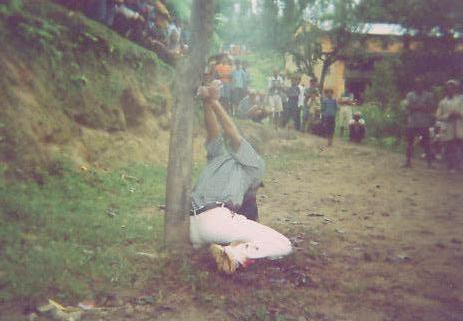 Yubaraj Puri’s photograph of his friend Gyanendra Khadka’s body a day after his murder in Jyamire, Sindhupalchok.
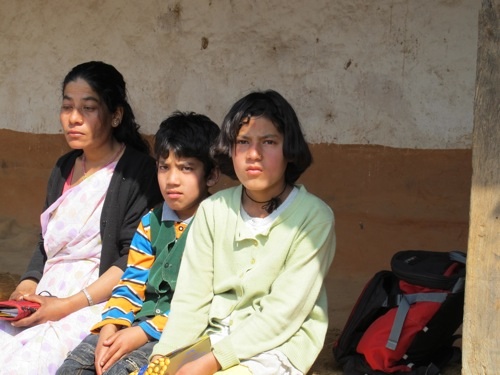 Gyanendra’s wife with their children Aswin and Asmita
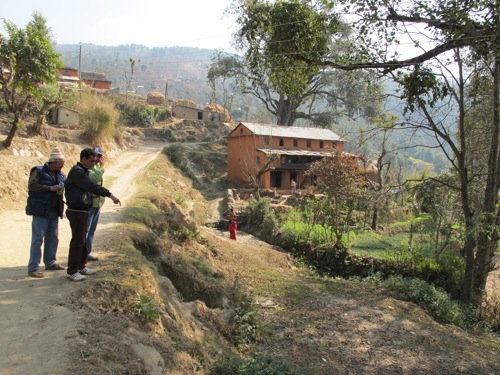 Yubaraj points to the spot where the volleyball pole used to be.
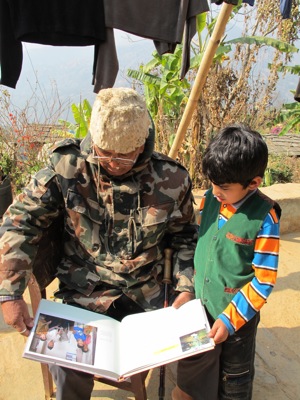 Gyanendra’s father and son Aswin look at the story about him in the book, People After War.