If I wasn’t a journalist, I’d sure love to have Rohit Ranjitkar’s job.
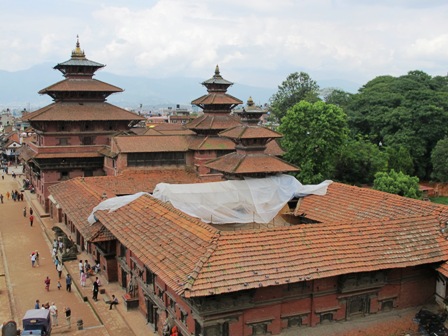
I meet Rohit amidst the scaffolded Sundari Chok at Patan Darbar. He has a large book in one hand with original photographs, and he is directing craftsmen as they painstakingly clean and repair the historic courtyard.
Sundari Chok was built by King Siddhi Narsingh Malla 360 years ago as part of his 'office' where he received visitors. The sunken Tusha Hiti royal stepwell with its pantheon of stone deities is one of the most exquisite legacies of the Malla period in the Kathmandu Valley. It has survived five major earthquakes, and while the palaces and temples around it collapsed in heaps of rubble Sundari Chok survived nearly intact for nearly four centuries, and still inspires awe and reverence among those who visit it today.
Sundari Chok has been used by the nearby police post as a dormitory and was closed to the public from 1993 on. Last year Rohit’s Kathmandu Valley Preservation Trust (www.kvptnepal.org) finally got permission from the Department of Archaeology to start renovating the courtyard with the sunken shrine and the Patan Royal Palace complex around it.
This is the crown jewel of the Kathmandu Valley’s Malla heritage; the wood and stone carvings of the deities reflect the craftsmanship and devotion of the past masters. You can tell Rohit is completely passionate about his job, and is not rattled by the lethargic bureaucracy and the apathy of officials he has to deal with.
“I focus on the job at hand, and remind myself everyday of the importance of what we are trying to do here,” Rohit tells me, “this heritage conservation work will remind future generations about our history and culture.”
There is an urgency to the work, too. Two of the bronze images inside the stepwell have been stolen. A bronze Durga disappeared 40 years ago, while the Laxmi Narayan with Garud that guarded the water spout was stolen just eight months ago. The other empty spaces that imply theft were in fact purposely left so to signify the souls of missing deities.
Rohit’s craftsmen fix the stone and bronze figures with concealed steel rods and cement so they can’t be moved. Besides the immediate danger of theft, there is the challenge of reviving the ancient stone and woodcraft that used to be passed down from generation to generation, but is now slowly dying out.
Says Rohit: “What amazes me is the talent and the devotion of the people who were responsible for building monuments like Sundari Chok. It is hard enough maintaining them, imagine how much more difficult it must have been to design and carve them from scratch?”
KVPT is involved in not just restoration, but also in reviving some of these ancient art forms. The craftsmen working in Sundari Chok are from Panga and Bhaktapur, learnt stone carving from their fathers and grandfathers, and themselves train apprentices in restoration and carving.
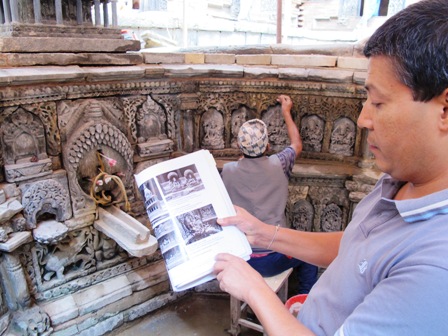 Rohit compares archival photographs with the originals in the Sundari Chok to guide his restoration.
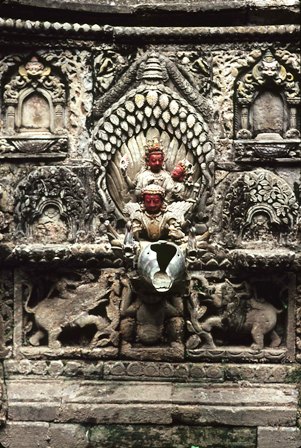 The bronze Laxmi Narayan from Mary Slusser’s photograph taken in 1968, and which was stolen in January.
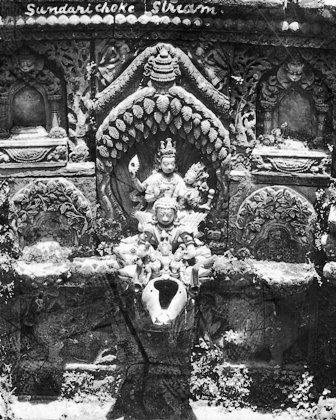 The water nymphs are still present in this picture taken circa 1900.
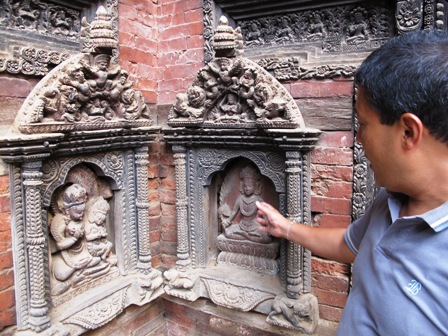 Rohit points out the pre-and post-earthquake wooden images in the southwest corner of Sundari Chok.
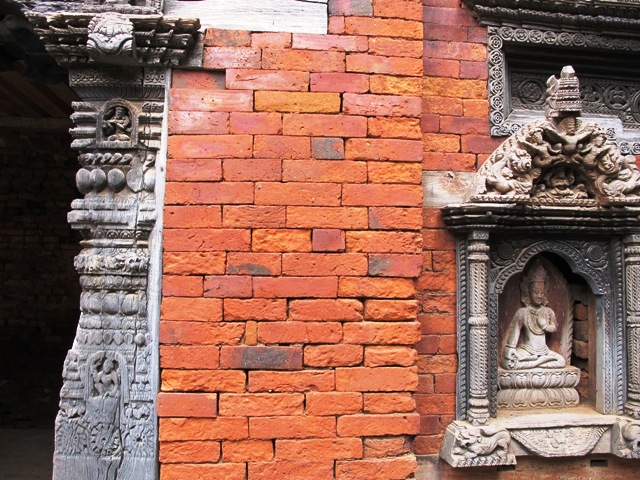 Sundari Chok is an exquisite blend of brick, wood and stone and will be a major attraction to tourists and pilgrims alike when it opens in late 2011
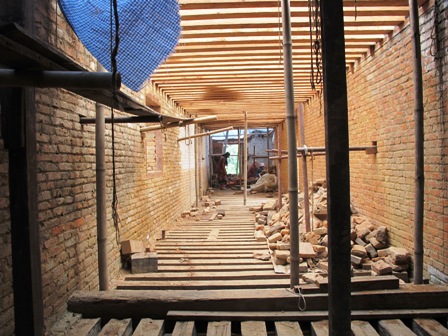 The upper floors of the Chok are being renovated and will be integrated with Patan Museum.
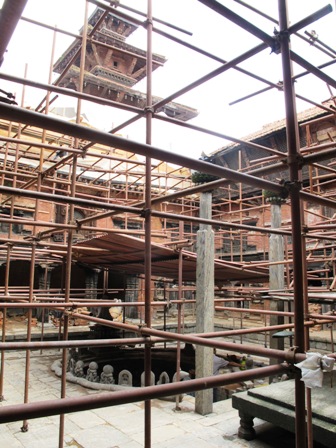 Sundari Chok in scaffolding, and an overview of the Patan Royal Palace complex, with plastic sheets keeping the rain out of the restoration work.