

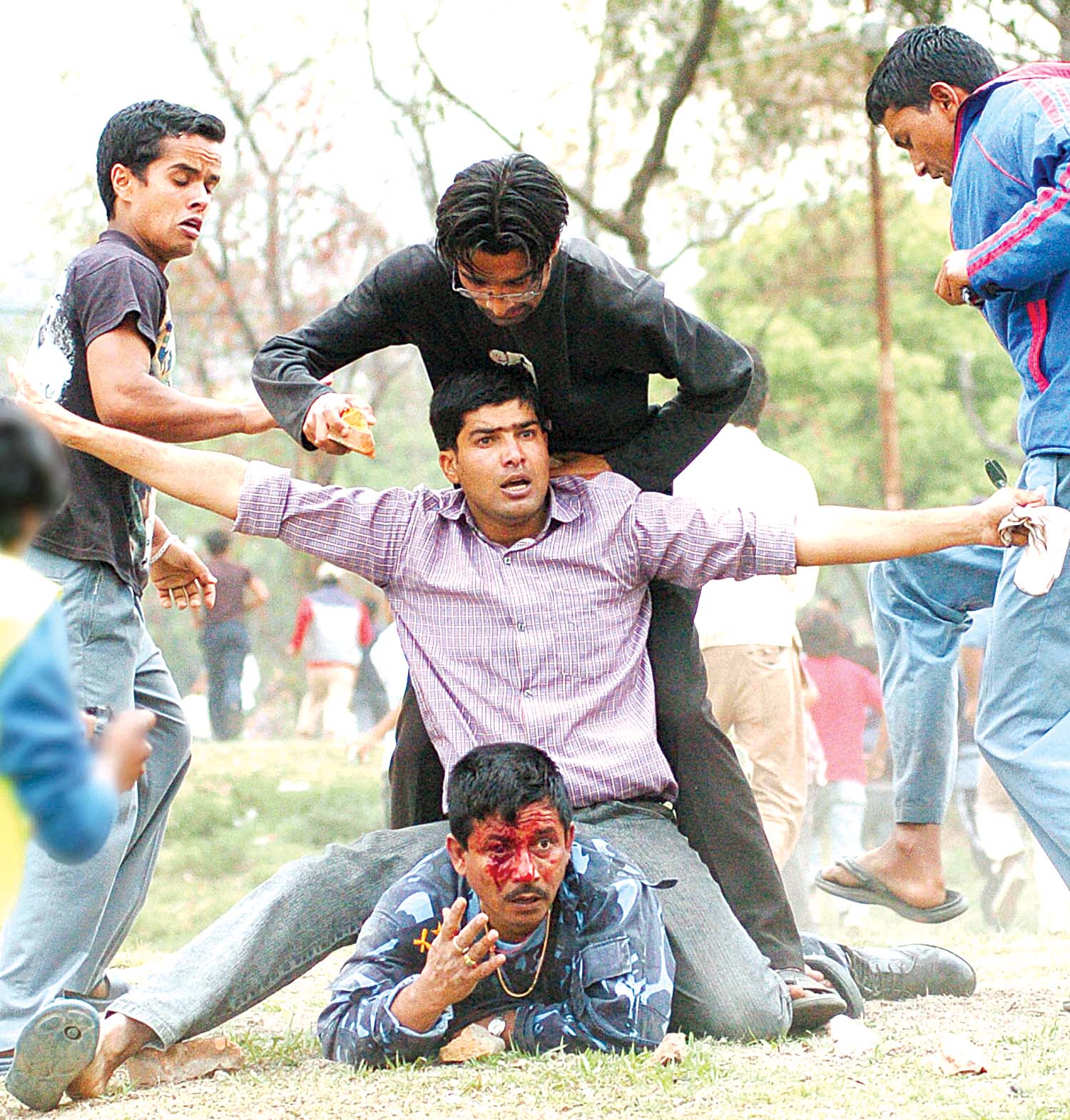
 PIC: SUNDAR SHRESTHA
Of all the characters in photographs from the book A People War that we wanted to follow-up on for the sequel, People After War, Gajendra Laudari was the most difficult to find.
Gajendra was an economics student at Tribhuvan University when the pro-democracy protests swept Kathmandu in April 2006. The university grounds on the slopes below Kirtipur were the hot bed of protests. The demonstrations were gathering strength: people were fed up with the war, and they felt Gyanendra’s efforts to turn the clock back to the days of absolute monarchy were endangering peace and democracy.
On 4 April, police were firing tear gas shells at stone-throwing students when police deputy-superintendent Sharad Chand was felled by a brick. The police withdrew because they had run out of tear gas shells, and the students ran to where Chand was and started bludgeoning him. A student sat astride the prostrate policeman and saved him from being lynched.
Sundar Shrestha was among the photographers who were taking pictures from some distance away, and his image of Gajendra sitting on top of Chand trying to save him from his fellow-students and Chand holding up his hand as if asking for help, was splashed on the front page of the newspaper the next morning. The photograph came to represent and symbolise the courage of one student not just to join the pro-democracy protests (most people were doing that) but to bravely stand up to ensure that the protests were peaceful.
But Gajendra disappeared. Try as we might to identify him in A People War, we couldn’t. Three years later, in 2009 when People After War was going to press, we tried one more time. An article appeared in Kantipur in Feburary 2009 titled ‘Who is this man?’ accompanying Sundar Shrestha’s photograph. A friend of Gajendra saw the article and rang up the reporter to say he had gone back to teach in his home village in Tanahu, a steep three-hour climb from the highway.
Reporter Santosh Pokhrel travelled from Pokhara to interview him, where the soft-spoken and modest Gajendra told him: “I felt I couldn’t allow myself to just watch a human being beaten to death. Anyone in my place would have done the same.” But that was precisely the point: no one else in his place came to rescue the fallen policeman, only Gajendra did.
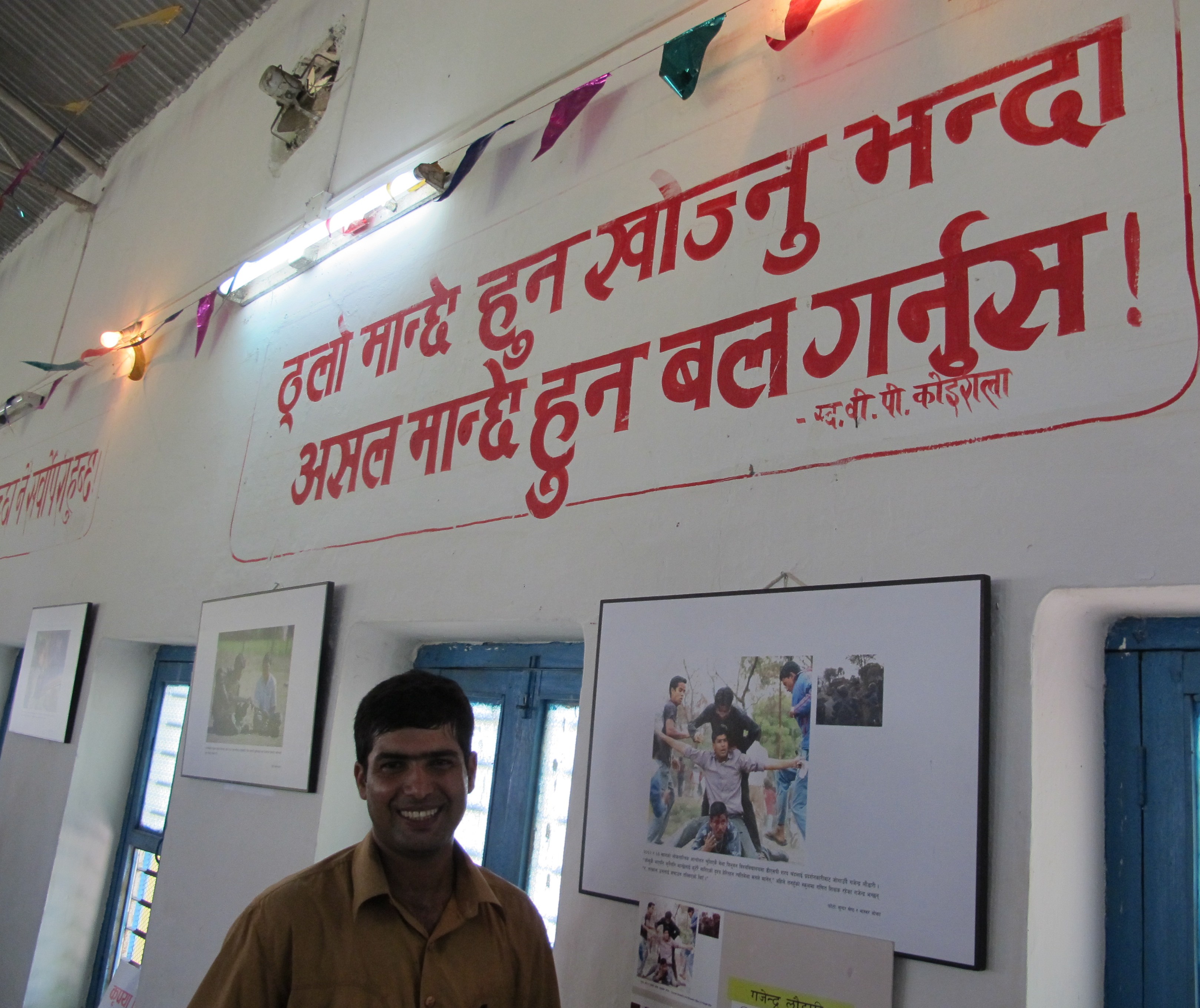 Gajendra Laudari speaks about the day the photograph was taken when it was exhibited in Damauli recently.
A few months ago, we got to Damauli of Tanahu for the exhibition of the photographs from A People War. On the way, we picked up Gajendra in Dumre, and travelled to Damauli together.
He gave us a more detailed account of what had happened that day in Kirtipur. “Actually, I wasn’t at the forefront of the demonstration, I was watching from the side. When the policeman fell, a friend of mine hit him in the leg with a stick and another student hit him with a broken brick, gouging his eye.”
At the exhibition, Gajendra points at the broken brick in the student’s hand that has blood on it, which I hadn’t noticed before even though I curated the book.
Gajendra looked at the other pictures from the war hanging in the District Administration Office Hall in Damauli and shook his head. “War and violence do different things to different people, you do things you never thought you were capable of,” Gajendra told me, "To tell you honestly, I wasn’t thinking about being brave or making a point for non-violent struggle, I saw a human being harmed and I acted to save him without thinking.”
Gajendra said the students were milling about, saying they should kill the policeman. He knew that the violence would escalate if that happened, and prove Home Minister Kamal Thapa right. Thapa had been saying that the Maoists had infiltrated the protesters. As a high school student Gajendra had wanted to be a policeman himself to “clean up the polluted politics”, perhaps that was a factor in him coming to Chand’s rescue.
After saving the policeman, Chand was taken away by American volunteer doctor Brian Cobb in an ambulance. Gajendra found himself caught up in a police baton charge and, ironically, the man who had saved a policeman’s life was himself beaten up by policemen.
Gajendra is convinced the only salvation for Nepal is though proper education that nurtures a new generation of Nepalis with a keen sense of civic duty and responsibility. “That is why I became a teacher,” he says, “and I just wanted to be a good citizen.”
An End to War, but Not to Danger – Columbia Journalism Review