

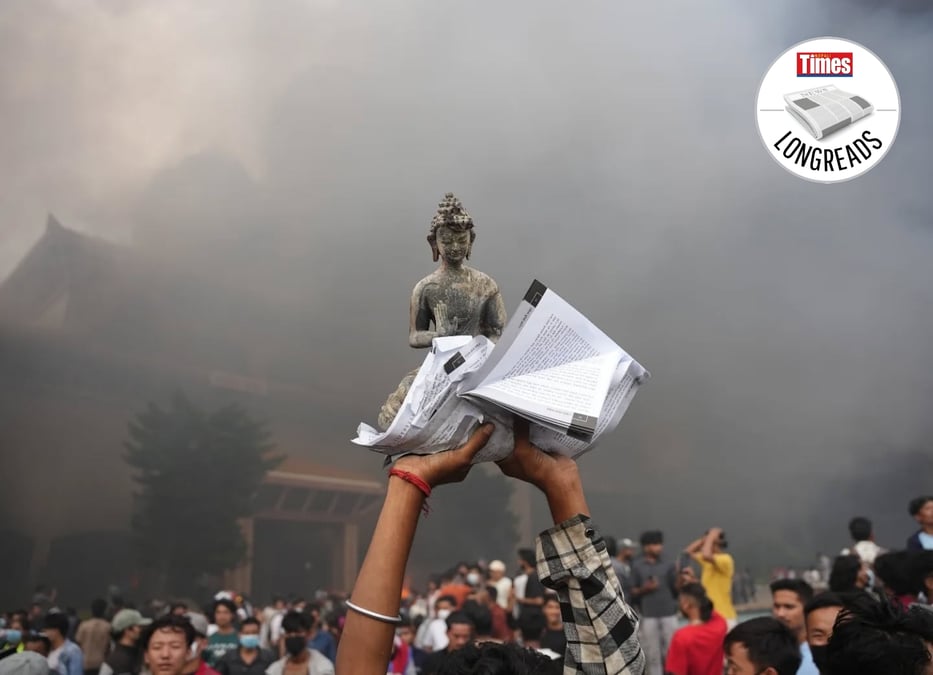
The events of 8-9 September 2025 will be remembered in Nepal for a long time for its consequential political ramifications.
The House of Representatives was disbanded. Prime Minister K P Oli decided not to resign, and in another huge lapse of statecraft, he was apparently told by the Army Chief that security would be enforced only after his resignation, which he then did.
Not a single firetruck went out to control as Singha Darbar, the Supreme Court, Parliament, supermarkets and private homes were set on fire. The report of the investigation commission focused only on the 8 September violence, and was conspicuously silent on the violence and arson on 9 September.
Quickly, a new non-party interim government was sworn in with the mandate to conduct a general election within six months. The RSP with its charismatic former Kathmandu mayor Balendra shah swept the poll.
The GenZ in Nepal, as elsewhere, is not a singular entity. The youth groups that publicly crystalised on 8-9 September do not represent all GenZ groups or individuals, and those taking part in the 8 September rally may be the first to acknowledge it.
It is also likely that the GenZ garb was intended, in part, for its popular appeal. It is also likely that the violence that shook Nepal on 8-9 September was partially a false flag operation under the GenZ banner.
The old parties and the ruling government dug their own grave, as generally happens when existing political frameworks crumble. But who pushed the body into the pit is not as clear as it is often made out to be. A host of agents, who may not even be aware of one another, begin to step in and it may never really be clear who pushed the body down.
A key organiser of the initial short march on the morning of 8 September has repeatedly said that the initiative was hijacked after the initial hours and rendered violent by intruders. This indicates the possibility that forces other than GenZ were engaged in violence and arson.
The youth rally thus may well have served as both an actor and a smokescreen for what went on during those two days. Agency for what happened on 8-9 September therefore cannot be placed solely upon the GenZ, even though its birth and rise in Nepal is real and consequential and in line with the historical rise of the youth around the world.
Within the last four decades, life in Nepal has been buffeted by tumultuous changes. Five decades ago, agriculture was the dominant sector of Nepal’s economy. More than 90% of the population was dependent on farming and it made up 45% of the country’s GDP. By 2025, the share of GDP in agriculture was 25%.
It is remarkable that remittance scales as high as agriculture, and indicates a large stream of internal and international migration. Nepal’s birth rate plummeted from 6.2 in 1976 to less than two in 2024 even as infant and maternal mortality rates came down sharply.
There is now a marked demographic bulge in the 15-24 age group, the classic GenZ social category. The average size of households came down from more than six in much of the 1980s to 4.4 in 2023. Literacy rates are approaching 80%. The share of Nepal’s population in the Tarai has risen from 38% 45 years ago to 54% today, while the population in the mountains fell from 10% to 6% in that period.
The age effect of this shift is fairly clear: it is the youth who migrate to towns, cities, and other countries. Transformation toward urban life, values and aspirations has become intense. There are new modes of acquiring information, enhancing education and health, generating livelihood, diversifying occupations.
But there are not enough meaningful jobs in urban areas, even while the cost of living in the cities is much higher. Half of all international migrants are between 25-34, and three-fourths of all Nepali households rely on remittance. For some years to come, the youth will not be looking to return to the farms, homes and communities they grew up in.
An overarching theme of the last few decades, thus, is one of incessant movement of peoples and cultures, change and diversification in sources of livelihood and, inevitably, shifts from close or primary belonging. The relations are often transient, as the new life is a move away from a community to one that is much less intimate, relatively anonymous and individualised.
SEMI-PROLETARIAT
This does not allow a large proportion of the young, in particular, to get rooted to a job, a locality, an income-level. It requires a floating status and identity of a de-anchored semi-proletariat from which both political activism and flammable violence can flow out.
All this has culminated in a massive rise in the relative power of the young. The rural area are hollowed out, fallow and home to the elderly who have lost much economic, political and cultural power. In contrast, the non-primary urban service sector is much more welcoming to the youth.
Compared to rural areas, there is a much greater chance of finding work in the cities. Even if urban jobs are intermittent and pays low, it allows many to network and find better jobs, possibly overseas.
Cities, towns and international locations of labour migration, where Nepali youth live and work in large groups, carrying on intense interaction among themselves about the country. These are the new sites of power, and are valorised as harbingers of the future.
The young worker who goes overseas to work remits not only cash, but also knowhow and information to those back home. The migrant worker may be physically away, but is virtually very much present in their households, communities and country.
The migrant, whether internal or international, is an active re-shaper of the politics of people and society back home. The cell phone, various web platforms and the social media are the most important instruments of belonging in times of incessant movement.
The mobile phone not only facilitates communication with the family and friends back home but also among the migrants themselves, building a belonging with a much wider world. The social web is also an eco-chamber among the in-group, who then narrow themselves by progressively shutting off others.
There have been reports of how the Nepali diaspora and some locals participated in the Discord conversations that functioned as a precursor to 8-9 September. The cell phone allowed the youth to erode the autonomy and influence of parents, siblings, wives, husbands, relatives, friends back home.
The smart phone is both a useful tool as well as weapon, it has both the best and the worst embedded within it. It can connect people, places, information, knowledge, but also amplifies the worst instincts. It can empower for good or turn into a lynch mob. Both were plenty in evidence in Nepal’s September Storm.
Although social media is hailed as a democratising force, it can also severely corrode upright citizenship. Anonymity is fundamentally inimical to the exercise of tolerance and becomes a caricature of democracy and free expression. Even so, there are times and places in despotic and authoritarian regimes where anonymity provides refuge.
Echo-chambering leads to a secretive and clique-based declarations rather than decisions democratically arrived at. One-third of all online posts of 8-9 September were reportedly fake. The ills of the social media, together with its promise, were in full display.
The GenZ phenomenon and events were outcomes of a severe popular resentment against the overbearing presence of political party structure widely seen as non-performing, corrupt and shielded by impunity.
Party fronts worked as organisational pillars functioning in the shadows as influence-peddlers, middlemen and agents who increasingly sought a mediatory role between the citizen and the government. Mediation diminishes citizenship, and also often comes with a fee. In addition, political fronts become contractors, traders, etc, cutting the line for government contracts as well as other form of access. These fronts often unionize and, supported by the mainframe party, exert illegitimate control over government or civil society, often feeding off public resources.
Such fronts erected by the old parties now span nearly all domains of public, civil, professional and even business life among farmers, squatters, civil service workers, laborers, students, teachers, school boards, physicians, veterinarians, engineers, scientists, professors, street sweepers, tailors, barbers, rural health workers and mothers’ groups, community forestry groups, non-resident Nepali associations abroad.
Elections across these organisations are fought along party lines, and from this base the political parties raise their cadres by the hundreds of thousands, competing to enroll ever more members. They can then boast about how many supporters they can ‘bring out’ into streets if it came to it.
All government appointments, including in the Supreme Court, statutory anti-corruption agencies bore distinct imprints of political parties. The political system had overreached, it performance seriously compromised across most domains because the parties sapped the agency and autonomy of citizens.
As elsewhere within such a system, sycophants rode over lay workers and citizens. Corruption was rife. While personal corruption was widespread, corruption for party purposes to enlarge the elections war chest, was possibly larger in scale. The level of public trust had rapidly eroded. Impunity was reported by newspapers to be widespread, possibly making it the leading cause of erosion of public trust.
Public disaffection spilled out in the election. The oligarchy had grown impervious to criticism from citizens. Indeed, top leaders were not even listening to their own colleagues within their own party.
The disaffection of citizens owed much also to the way the legislature and the judiciary functioned. Citizens expect integrity of their lawmakers, but many were not serious about their job. Committee meetings often lacked quorum. Many MPs often marked themselves present, but left immediately. The Committees were often rubber stamps for party positions.
The judiciary, in turn, has also for long been regarded as a bastion of corruption. Judges and justices nominated by committees of politicians, eroding its legitimacy. All in all, key institutions of the state lost much public trust in the last several years. The higher echelons of government were mired in indiscipline and rot.
This does not imply all the leaders of the old parties did everything wrong and that was why they bit the dust. But growing public distrust was the substrate on which the GenZ movement happened. Ultimately this led to a party system that pretended to rely upon grand old ideological narratives, cadre strength and hierarchy was bound to collapse.
It is likely that the new parties, including the RSP which has seen a spectacular rise, will rapidly seek to bulk up, spread out, hierarchise and colonise civil space. But recreating that culture, will merely take us back to square one. Becoming strong is quite different from growing obese.
When the world is speeding up with connectivity and instant communication, and in a state of turmoil it is difficult to remain wedded to the old metanarrative of capitalism and liberalism on the one hand and communism and socialism on the other. It seems this is where populism comes in.
People are looking for a quick panacea, and that gives rise to makeshiftism. Notions of long arcs of history may or may not be right but one must pass through shorter and lower arcs.
The young GenZ should be able to respond to rapidly changing global and local politics better than the older generation. They would certainly not be wedded to the old political-historical narratives of the legacy parties and older citizens. For them, short termism and populism is a more practical alternative because the longterm future is so uncertain.
Many of the young are aware that they have to think in terms of Nepal-in-the-world rather than Nepal-and-the-world. The young possess a thicker, sharper and personal sense of their potential futures in Nepal and across the world. The young leaders may not comprehend the challenge of Nepal being a state within an interstate world, but at least they will see it with fresher eyes.
It may also be time to question and perhaps put to rest the criticism commonly made against the leaders of old parties. It is not merely that the leaders have aged and have played musical chairs for far too long. It is rather that the political parties themselves have become old and unable to grasp the nature of a rapidly changing world.
The political ground that the old parties occupied shifted when the initial GenZ groups hit the street. The obese and obsolete parties fell because they could not support their own weight in this period of history. The election showed that party emperors were in fact naked.
DE-RISKING
On the other hand, it is not a given that the new young leaders will be capable of navigating the political waters and prove worthy of the public trust they have been bestowed with. We live in an increasingly dangerous world and need to take steps to minimise risks.
There are a number of strategies for this. Revitalising agriculture and local communities must top the list of options. Farming puts food on the table, gives work and income to a majority of citizens – including women, Dalits and senior citizens in particular and lifts up the poorest.
With global instability threatening migration, agriculture provides an option for returnees in the rural communities. Legal, institutional and technological strategies to revive farming can be a key de-risk strategy.
The old parties have lost much public trust and it will be some time, if ever, that they regain the old glory. Yet, it is important to be thankful to the old parties and leaders for the gains they have made. Grace is a winning formula, including in politics.
Three hard-won gains that Prime Minister Balendra Shah may want to honor would be:
Republican democracy. It is important to build a political, economic and cultural order where no birth right or birth privilege exists.
Secularism. Politics and public life must not be left to the magic, superstition, demons and gods. It should be about Constitution, laws and citizenship. A polity must not restrict restrict citizens in their private lives from imagining, hoping, dreaming, or worshipping. But the state should maintain its separation from religion. Regardless of what Balendra Shah accomplishes during his tenure, this huge gain must not be squandered but pushed further to delegitimise sectarian identities and ideologies,
Social democracy. This mode of governance remains enshrined in the Constitution in at least five chapters. However, despite successive left-of-center parliaments this principle has remained nearly unimplemented.
Nepal now lives within a world-capitalist order and it can thrive, in this particular period of world history, only by becoming a better player in this order. Yet, hunger and severe poverty, low-quality public education and public health, unproductive farms must not be allowed to burden families and hurt the future of Nepali children.
Further, only a part of the investment required for a social-democratic re-alignment is financial -- the rest is political, cultural, legal, managerial. The state is a collective enterprise owned and run by all citizens, and all of them must be enabled to function at an optimum level.
Chaitanya Mishra is a professor of Sociology at Tribhuvan University.