
 |
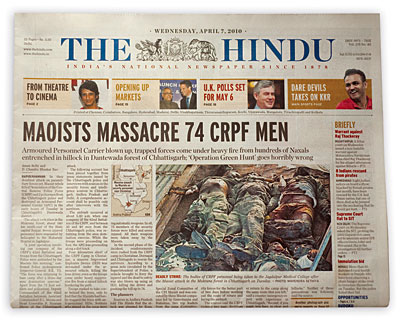
The fear was palpable along the Konta-Dantewada highway in south Chhatisgarh in November 2007. In a village off the highway, very close to Chintalnar where Naxalite Maoists massacred 76 Indian security personnel on Tuesday,
a tribal leader told us, "This war will continue for at least ten years."
Thousands of displaced tribals were housed in makeshift camps by the road under the government's ill-thought out and destructive Salwa Judum campaign. This involved forcing tribals out of their homes, creating strategic hamlets, then deploying tribal youth to fight against the Maoists. The Maoists viewed tribals living in these camps as government agents, and often attacked them.
Since then, the government has rethought the Salwa Judum campaign. But the alienation it bred is starkly visible. Sandwiched between an often absent, coercive state and brutal Maoists who were at least embedded with villagers, many opted for the rebels. This week's operation would not have been possible without local support.
Kashmir, the Northeast and Punjab have shown that the Indian state is enormously resilient, can absorb shocks and has a high bleeding capacity. But the challenge from the tribal-dominated, mineral-rich areas of central and eastern India will test the government in newer ways.
In these pockets, young men and women do not see the state at all. Abujmadh, where Arundhati Roy travelled to write her gushing essay on the Naxals, is an area the Indian state has never even surveyed. If the government does appear, it is not in a welfarist but predatory avatar.
Inequitable policies, absence of justice, land issues, a corrupt administration, a dearth of mainstream political actors, forced displacement, and insensitivity to non-violent movements have helped create space for an armed outfit that questions the legitimacy of the political system. What is happening here is an exact replica of how the Nepali Maoist movement evolved.
Raise popular issues; mobilise people; eliminate key local rivals; exert exclusive control over key base areas; force the state to unleash a violent operation to expose its 'real character'; utilise human rights violations to expand the recruitment base; and pursue political and military tracks simultaneously. The violence escalates until a stalemate forces a rethink.