

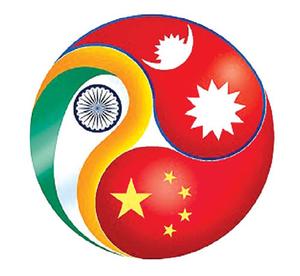
 During his visit to China last month, Indian Prime Minister Narendra Modi made a pitch for trilateral cooperation to help Nepal with earthquake assistance. He and Chinese president Xi Jing Ping agreed to work with Nepal for mutually coordinated reconstruction and rehabilitation.
No doubt, this is a great leap forward in Indian foreign policy, which has traditionally preferred to deal with its neighbours bilaterally. In fact, New Delhi has steadfastly opposed any attempt by Nepal and Bangladesh to work together with India in regulating the flow of Himalayan rivers.
At the International Conference on Nepal’s Reconstruction in Kathmandu on 25 June, India and China together pledged more than half the $4.4 billion in grants and loans – leaving Nepal’s traditional bilateral donors trailing far behind. This was the best indication yet of how the world’s economic power centre has shifted to Asia. It is Nepal’s great fortune that we have these two giants as our immediate neighbours to the north and south.
Nepal’s governance failure pre-dates the earthquake. In fact, ever since 1990, we have seen a polarised partisan paralysis that has kept Nepal from leaping ahead in energy, infrastructure, investment and tourism. Even with Nepal’s much-touted successes in community forestry and maternal-child health, the groundwork was laid with the move towards decentralised development during the Panchayat.
For now, it is clear that Nepal’s needs in post-earthquake reconstruction is not so much in cash to rebuild physical infrastructure, but to enhance our governance and management capabilities. That is not something money can buy.
Besides their monetary assistance, therefore, India and China should aim at building the management capacity of their landlocked neighbour so that it is able to emulate both of them in accelerated, sustainable and equitable growth. India, under Prime Minister Modi, has departed significantly from the policies of previous New Delhi rulers in dealing with neighbours and beyond.
Indian analysts themselves have said that New Delhi’s earlier strategy was to create ‘intrinsic instability’ in the neighbourhood in order to gain advantage in bilateral dealings with them. India seems to have shed this policy and, particularly in relation to constitution drafting in Nepal, has left it more or less to the elected Constituent Assembly to come up with its own solution. There seems to be a sense that Nepali politics is so unpredictable that micromanaging affairs here either backfires, or is counterproductive to India’s own interest.