

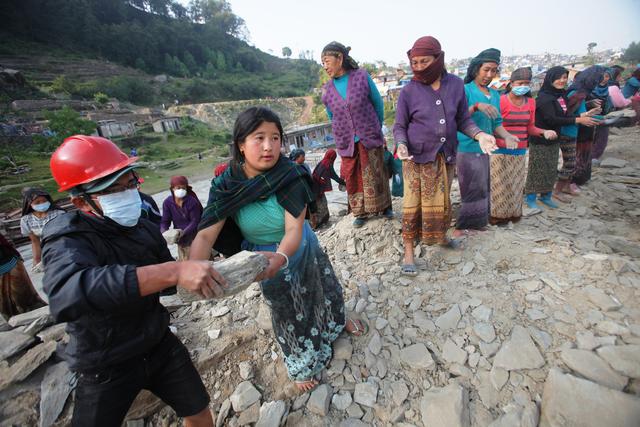
Ahead of a major donor conference scheduled for 25 June in Kathmandu, Nepal and its international partners needs to seriously think about what kind of help would be most cost-effective and sustainable.
By taking it so seriously, the government is going all out to convince donors to overcome their misgivings about the lack of accountability and governance and open their purse strings. It has put a target of Rs 6 trillion for earthquake rehabilitation.
As the ongoing relief work has once again shown, making resources available is only part of the story. Getting it quickly and efficiently to the neediest beneficiaries is the bigger, and often unmet, challenge. Relief supplies have been derailed, hijacked by the national government or local political cadre. Even some well-meaning NGOs didn't really care where the supplies went as long as they had their handover photo-ops.
The Rs 15,000 immediate relief for families whose houses were destroyed is also being sidetracked by the not-so-needy, and the number of houses in certain VDCs has exceeded the total before the earthquake. Political goons are threatening and forcing VDC secretaries to certify themselves as victims many times over. Despite a quarter of a century of democratic institution-building there is still no accountability and nothing to protect us from local political tyrants.
In a column titled 'Follow the people' in this space two weeks ago, I drew attention to the exemplary work done by forestry user groups and Female Community Health Volunteers in Nepal -- a feat made possible through concerted support of many donors coordinated by the Nepal government. It proves that building national capacity for managing development and relief must be a vital part of what is discussed at the donor meeting. There is no point re-inventing the wheel.
We now know that money alone does not make rehabilitation work. In fact, by itself it is more of a nuisance and distorts and worsens the power relations between local 'high caste' feudal elite and their poorer 'low caste' neighbours by widening the income gap. In fact this is why Nepal has remained desperately poor and underdeveloped despite 25 years of 'representative democracy'.