
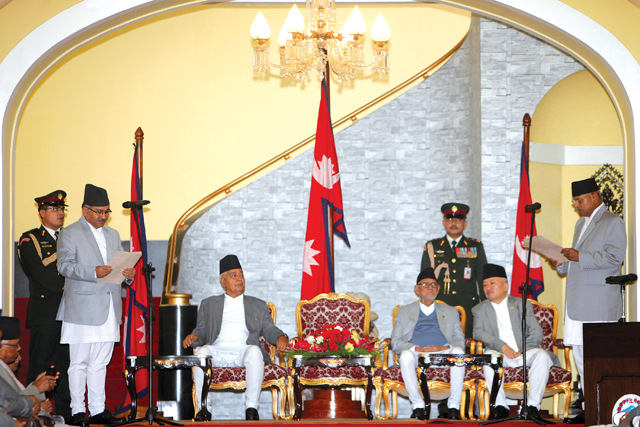
Photo: Bikram Rai
Compared to his predecessor from whom he took over on Wednesday, Justice Kalyan Shrestha has had an untarnished 40-year career. This is a man known for his integrity and sense of fair play, and his appointment comes at a time when the Supreme Court has been dragged into controversy and disrepute.
When Chief Justice Ram Kumar Prasad Shah was appointed some nine months ago, he promised that he would respect the separation of powers and never compromise the independence of Judiciary. This was a legacy of the controversial appointment of Chief Justice Khil Raj Regmi as Chairman of the Interim Election Government in 2013. But it was under Shah’s watch that the Supreme Court got embroiled last month in another tussle between the Legislature and the Judiciary with the interim order issued by the single bench of Justice Girish Chandra Lal on the 16-point agreement between four political parties.
Some of Shah’s other verdicts like the one on ex-crown princess Prerana Rajya Laxmi has been criticised for its lack of transparency even by other justices and the Nepal Bar Association. The case which was filed on January was hastily decided in four months, unprecedented in Nepal’s judicial history.
His decision to appoint Deepak Timilsina as the IT adviser, a person who was fired by former Chief Justice Ram Prasad Shrestha was investigated by Himal Khabarpatrika two weeks ago. But the most damning blot was his acquittal of Yeshe Lama, a fake doctor from Humla who had embezzled millions from the American charity, Citta, to build a hospital in Simikot. The story has been doggedly pursued by Bhrikuti Rai of the Centre for Investigative Journalism for three years.
Shah also failed to appoint justices of the Supreme Court which has a massive backlog of cases despite saying time and again that it was his top priority. In the end, he blamed the Nepal Bar Association for not recommending its representatives to the Judicial Council.
Justice Shrestha’s foremost challenge now is to face the new constitution and its provisions related to Judiciary. Most provisions in the draft like a separate constitutional court and the reappointment of Justices after the promulgation of new constitution have always been criticised by the Judiciary.