
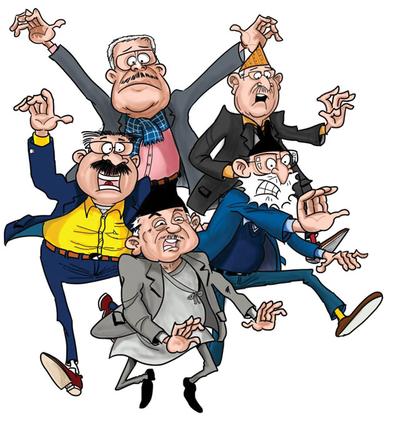
Cartoon: Diwakar Chettri
Hundreds of thousands of people across 15 districts affected by the April earthquake are still awaiting food, shelter and medicines. But what are they discussing in the corridors of power in Singha Darbar these days? Who gets to be the next prime minister and when.
A national crisis of this magnitude should have put the government and its agencies at its efficient best and united political forces across the spectrum. But politics is a hard ball game of power, and crisis provide all an opportunity to make political capital.
All the Maoist chairman Pushpa Kamal Dahal had to do was stoke KP Oli’s ambition to become prime minister to change the current discourse of Nepali politics.
Prime Minister Sushil Koirala’s own goal may have been to be at the helm when the constitution is drafted, take credit for it and then make a graceful exit. But the earthquake has shaken things up.
The Maoists sniff advantage that putting an ailing Oli in power will open opportunities for them because they know Comrade KP is a man in a hurry. However, sections of the NC see no reason to handover to Oli right now since the gentleman’s agreement was that Koirala will step down only after the constitution.
Which is why they are now racing the clock to try to ram through a constitution. But what after that? A national reconstruction government led by Oli has set off competition for power sharing. The long-term political capital to be gained during this period means everybody wants just a little bigger share of the pie. With local elections looking probable by the end of the year, there is fierce competition for powerful ministerial berths.
The NC, UML and the opposition Maoist-Madhesi alliance have intensified in the past few days, most kinks in the constitution are being ironed out. Unlike in the past, federalism and the governance are not the sticking points anymore. The eagerness shown by the Maoists and a section of Madhesi alliance to jump into Oli’s bandwagon means that Maoists do not see their stance on statute yielding them any political brownie points. Instead, a visible role in the national reconstruction government may just be what Dahal and his comrades are looking for to regain lost political stature.