Nearly two weeks after the devastating earthquake Bal Sundar Khatri and his father Ramji Khatri are still sifting through the rubble of their house in Sindhupalchok, looking for anything that can be salvaged.
Bal Sundar works for Nepal Police and was posted in Kathmandu when the earth beneath him shook at noon of 25 April. “I was helping with rescue in the capital when my wife called to say that our two-year-old son had been killed when our house collapsed,” says Bal Sundar.
It was nightfall by the time he reached his home to see that he had lost his child, his home, and most of his livestock.
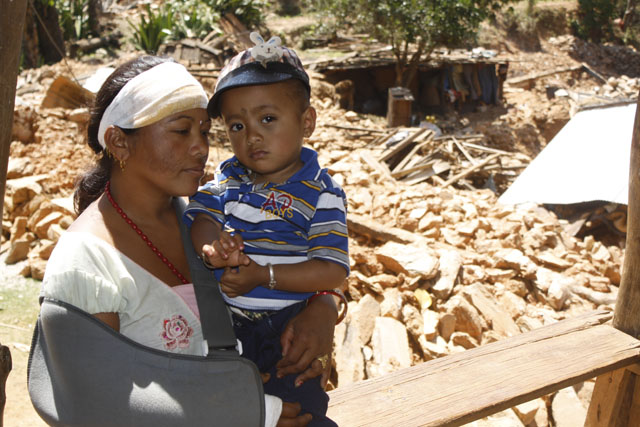
Photo: Anurag Acharya
Gyanu Sapkota, 28, of Khatrithok is among the fortunate few. When the quake hit, she rushed into the house to save her son, but the roof above her fell on her head. She remained conscious and held on to her baby. She was rescued by neighbours several hours later.
Gore Sarki wasn’t so lucky. His 4-year-old daughter was killed. His wife had just left him, and no one has seen him after he cremated Bhawana that afternoon.
Kamal Khadka, Suman Khadka and Bishnu Khadka were also mourning the death of their father when I reached the village of Matichaur. The family was preparing the field for maize when their father went home for lunch. He was in the alley, surrounded by houses when the walls collapsed. For 24 hours, the family and neighbours searched for him in the ruins. The next day four soldiers had come to search for a relative, but they were too exhausted to help. “They said they’d come back, but never did,” Kamal said.
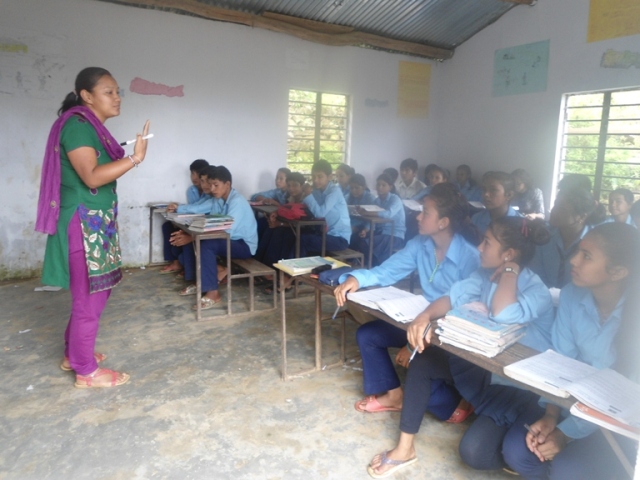
In Khatrithok, hundreds of villagers lined up patiently at the village school for food being distributed by Teach for Nepal, which lost one of its teachers, Sujita Chaudhary. She was a science teacher at the local Bhimsen Secondary School and died when her house collapsed.
“It is an emotional moment for us, coming to the village where we lost one of our own,” said Siri Hang Rai, one of the volunteers for Teach for Nepal.
At least 12 people were killed in Khatrithok and an unknown number of cattle were lost. Nearly all the 126 houses have been razed to the ground. Karkitar lost 11 people, Maajhi Gaun 60, Mure 6 and four died in Sukute. Unlike other parts of Sindhupalchok, where locals dumped livestock and even human bodies into the river, here they observed proper last rites for the dead, and dug a mass grave to bury the cattle.