
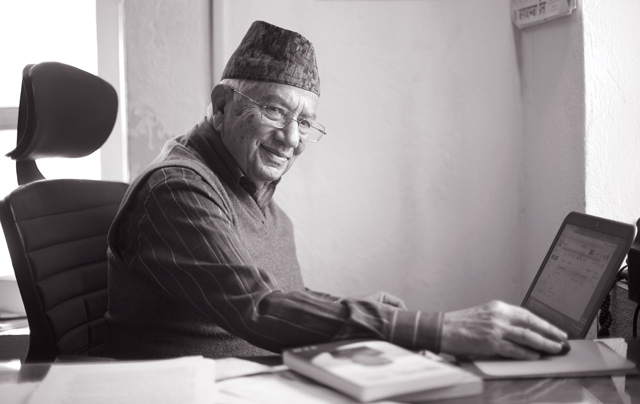
Kamal Mani Dixit, who passed away in Kathmandu on 29 December at the age of 87 was the closest Nepal came to having a Renaissance man. He was also one of those rare Nepalis who was a front-row witness of Nepal’s tumultuous modern history as it unfolded in his life time -- from the absolute rule of the Ranas in the 1940s to the overthrow of the oligarchy in 1951, from King Mahendra’s dissolution of a popularly elected government in 1960 to the set-up of a constitutional monarchy in 1991, from the Jana-Andolan III in 2006 which turned Nepal into a secular republic in 2008 to the promulgation of the seventh Constitution in 2015.
Dixit was comfortable being himself in times both good and bad, taking all these changes in his stride, and lived a life filled with literary joys, and devoted to public service, philanthropy and to the causes of free speech and democracy.
Born in Gairidhara in Kathmandu in 1929, Dixit grew up in a family that had modest financial means but prized, as was common then among Kathmandu’s upwardly mobile Brahmins, religion and education. Dixit had earned his Bachelor’s from Banaras Hindu University and had started working in Kathmandu when his family came upon wealth, mostly in the form of land near Patan Dhoka, through the bequest of Rani Jagadamba Rana, whose wish was that the wealth be put to use in perpetuity to serve the public, and for the public good.
Rani Jagadamba could not have found a more scrupulous and creative steward of her trust, for Dixit spent the next six decades putting the inheritance to benefit the public starting with the fields of education and Nepali literature.
Dixit managed Madan Memorial Girls’ School in Lalitpur, and started and ran Madan Puraskar Guthi, which not only oversees the go-to archive for Nepal’s literatures, but also awards the prestigious Madan Puraskar to writers annually. A man whose devotion to Nepali language and literature knew no bounds, Dixit started and edited Nepali, a literary quarterly, and authored 75 books that ranged in subjects from contemporary essays to historical narratives to commentaries to memoirs to criticisms and mordant social observations. His writing style bore the hallmarks of clarity, simplicity, wit and self-effacement -- all of which he used to great effect to let ideas, observations and memories play out in the public sphere.