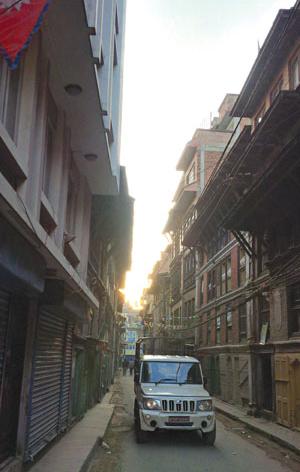
 Heavily built-up Kathmandu is on top of the list of cities around the world most vulnerable to earthquakes. Pic: Kunda Dixit
National Earthquake Safety Day on 15 January is a reminder to be ready for the coming Big One
When (not if) the next big earthquake strikes Nepal, don’t ask what the government can do for you, ask what your community can do for itself.
Endless political gridlock and dead-end development has distracted government attention from preparing for a long overdue mega-earthquake in Kathmandu, a city experts say is the most vulnerable in the world to seismic risk. A bill to set up a Disaster Risk Management Commission is stuck in parliament, and a turf war between line ministries has left contingency plans in limbo.
“Our best option is to decentralise risk management to the household, village or municipality level,” said Surya Narayan Shrestha, an engineer with the National Society for Earthquake Technology-Nepal (NSET) which is working with town and village councils in enforcing building codes and training staff to ensure compliance.
The last big earthquake to hit Kathmandu was 8.3 magnitude and struck at 2.30PM on 15 January 1934 killing 8,000 people in the Valley and another 10,000 in the rest of Nepal and India.
Experts predict that an earthquake of similar intensity today would destroy 60 per cent of the buildings in the city, and kill at least 100,000 people outright. Hospitals left standing will be understaffed and overwhelmed with the wounded. Relief will be affected by crippled airports and highways.
Frustrated that the draft Disaster Risk Management Act does not pay sufficient attention to preparedness, and has not been ratified by parliament even after five years, activists and donors are in a dilemma – try to rework it or lobby to finally pass a faulty bill? The Home Ministry is preoccupied with post-disaster response after earthquakes and floods, but risk management is about being ready and should be under the purview of the new commission and coordinated by the Prime Minister’s Office.
Interactive map of earthquakes in Nepal since 1255. Click on the circles for more information.
Despite the slow movement on legislation, experts say Nepal is regarded as a role model in the region for its innovative approach in its School Earthquake Safety Program in which the Department of Education works with a consortium of donors to conduct drills and retrofit vulnerable schools. A similar program to strengthen six Kathmandu Valley hospitals to withstand earthquakes and equip them to deal with mass casualties is also in the works.
“The idea is not just to make schools safe but the whole school system,” Shrestha explained, “not just retrofit hospitals but make the hospital system prepared for disasters.”
NSET is working with municipalities and village councils to include compliance to building codes in their minimum performance criteria, encourage self-regulation by architects and contractors to promote seismic resistant designs, and train masons to reinforce self-built homes.
“We have to be prepared to be prepared,” said NSET’s founder Amod Mani Dixit, “earthquakes don’t just kill people they kill countries. We don’t have to wait for the constitution or elections to be ready.” Since it will take time for the government to act, NSET is trying to scale up its activities and involve institutions in disaster preparedness.
Learning from earthquakes elsewhere in the world, a damage assessment of Kathmandu Valley has also been drawn up with maps of open spaces with prepositioned water supply and emergency equipment. All that needs to be done is to put those plans into action.
“To know what an earthquake is like you have to live through one,” says 89-year-old Bhuyu Maharjan of Patan, who was six years old in 1934. “We thought it was the end of the world.” He described the ground moving like waves, deep cracks in the fields. The Taleju Temple in Mangal Bazar collapsed, and 22 people were killed inside the Honacha eatery nearby.
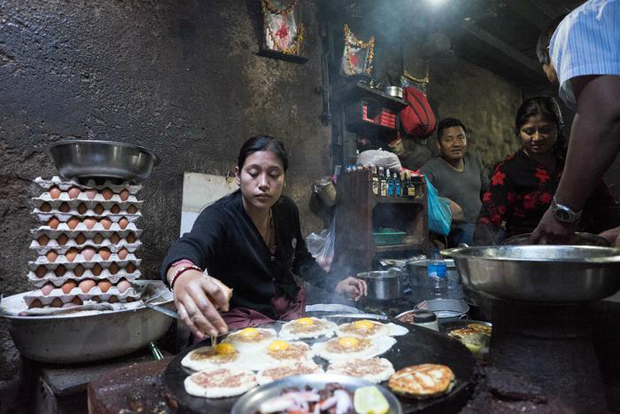 AS FRAGILE AS EGGS:The Honacha eatery in Patan was reconstructed on the same spot where it was destroyed by the 1934 earthquake, killing 22 people. Pic: Kenji Kwok
Eighty years later, eyewitnesses to the Great Earthquake of 1934 (read testimonies, below) describe the terror of trying to flee collapsing buildings, the pall of dust over the city, living in tents in the cold with very little food for weeks.
Shyam Maharjan’s father had gone to the Bagmati River for a bath when the quake struck. He remembers water gushing out of cracks on the ground, and suddenly the river flooded as if it was the monsoon. He had to swim across to get back home. “For many years later, my father was always scared even when there were minor tremors,” Maharjan said.
Man Maya Shakya, 70, remembers her mother telling her of “walking on the roofs of collapsed houses” because the streets were blocked with rubble. Her uncle had been buried in one of the houses, and had to be dug out. There were so many corpses they were piled high and brought to the streets to be cremated.
If that was what it was like when the Valley’s population was only 200,000 and houses were mostly brick and timber, the next Big One in a built-up city of 2.5 million would do much more damage.
_______________________________________________________________________________________
“There was so much dust it became dark” as told to Sonia Awale
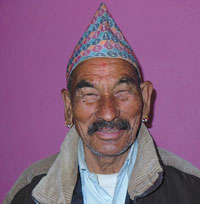
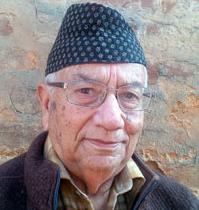
(Click on photo thumbnail of Bhuyu Maharjan, Indra Nath Aryal and Chirmai Awale for video)
Bhuyu Maharjan, 89
I was playing marbles with one of my friends right there (points across the square). My aunts were washing clothes at that well. Half the house fell on top of the well, and we narrowly escaped. There was dust everywhere, it covered the sun and it suddenly went dark. Everyone came running to the lachhi (square) because it was the only open space, and it was crowded with families. My grandfather’s leg was trapped under one of the fallen buildings. Another man’s leg was crushed by a wooden pillar, and he was yelling for help so they cut the pillar to free his leg. One of my relatives was at a funeral for his dead father when the quake struck. He had just enough time to rush out, but the priest was buried under the building by the river and his body remained there for 16 days until it started to stink.