 KUNDA DIXIT |
It's that time of the year again, as Nepal gears up to mark another anniversary of the devastating 8.4 magnitude earthquake that struck Kathmandu at 2:30 pm on 15 January 1934, and killed at least 10,000 people.
As in previous years, government ministers will give speeches all next week and light lamps at disaster preparedness workshops. But the consequences of an earthquake of similar strength to the one nearly 80 years ago in 1934 are so unthinkable that no one seems to know where to start.
The public is aware of what an earthquake can do, but few are building seismic-resistant homes, retrofitting weak structures, or planning for the aftermath of a disaster. Historical records show that a big earthquake strikes central Nepal every 70 years: the next one is due any day now.
Earthquakes cannot be predicted exactly because scientists can't tell when the tectonic stress is ready for release. However, it is certain another 8.4 magnitude earthquake will strike Kathmandu, we just don't know when. In one scenario, 60 per cent of the buildings in Kathmandu Valley will be destroyed, more than 100,000 people will be killed outright depending on the time of day, and three times that number injured.
Many of the 12 big hospitals in Kathmandu will be damaged, and there will be few open spaces left for survivors. International relief will not get through because of damaged airports and roads. Casualties will be even higher if the quake strikes during school hours.
 |
However, awareness generation, donor pressure, and scare tactics seem to be finally shaking up the government. "There is more awareness about earthquakes and preparedness," explains Amod Dixit of the National Society for Earthquake Technology-Nepal (NSET).
Two earthquakes struck Haiti and Chile in 2010. More than 300,000 people were killed in Haiti, and fewer than 600 were killed in Chile, even though it was a much bigger earthquake, mainly because the Chileans have better preparedness and stricter building codes. "Nepal has Chile-like earthquakes in a Haiti-like environment," says Dixit, "but we can also be Chile-like if we are prepared like they were."
Despite political instability and an aversion to long-term disaster planning, the government is finally beginning to retrofit schols and hospitals, implementing building codes, planning for prevention, and disaster relief.
Nepal took a big step forward in 2009 with the National Strategy for Disaster Risk Management. A new National Disaster Management Authority will be formed, and the National Planning Commission will integrate climate change and disaster reduction risk management into its development strategy.
The government along with international partners has also formed the National Risk Reduction Consortium (NRRC) to prepare for future disasters, including earthquakes with school and hospital retrofitting on top of the priority list. The consortium includes the Asian Development Bank (ADB), the Red Cross, UNDP, World Bank, AusAid, DFID, the EU, Japan, the US Embassy, and WHO.
Pradip Koirala of the Disaster Management Section at the Ministry of Home Affairs says work has been done, but there is much left to do:"We have identified 83 open spaces for evacuation in Kathmandu Valley, emergency water supply, and sanitation."
Kathmandu is ranked number one in the top 10 cities around the world where a catastrophic earthquake is imminent. But John Galetzka of the California Institute of Technology says Nepal today is better prepared after the Haiti and Japan quakes. "Remember that the UN mission in Haiti suffered, and they don't want that to happen again in Nepal," Galetzka explained, "they also know they will have to step in for relief and rehabilitation after a future disaster."
Foreign embassies and donor agencies have their own post-earthquake evacuation plans, they coordinate relief strategies for citizens, and conduct regular drills. Foreign earthquake experts have tried to convince Nepali authorities that spending a dollar on prevention and preparedness will save hundreds of dollars in post-disaster relief. But until recently, no one was listening.
Man B Thapa, manager of UNDP's Comprehensive Disaster Risk Management Program, says: "If you understand the value of preparedness you can reduce risk, so a school built without proper safeguards is not a good investment."
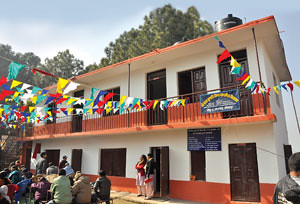
Because the task is so overwhelming, it has been difficult to figure out where to start. The government has decided that schools and hospitals are the most urgent, and has undertaken an ambitious retrofitting campaign with donor support (see box).
The Kashmir and Sichuan earthquakes in the last 10 years were wake-up calls because of the thousands of children who died under collapsed classrooms. Most schools in Nepal are private and housed in buildings not designed as schools. Says NSET's Dixit: "If we were a rich country we'd demolish them all and build stronger schools. But we're not."