
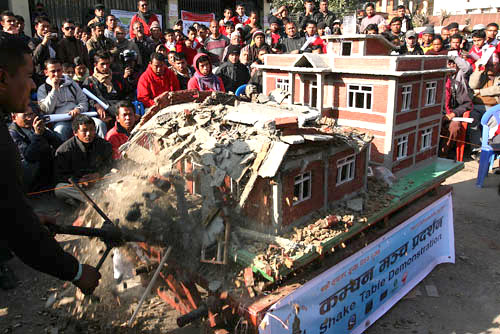
 PHOTO: KIRAN PANDAY
An earthquake hitting Kathmandu Valley is like all-out nuclear war. If you think about it too much you’ll go mad.
So most people try not to worry too much and get on with their lives. The experts say it is not a question of 'if' but 'when' we will see a repeat of the 1934 jolt along the Nepal-Bihar fault that registered 8.3 on the Richter scale.
The next time the epicenter could be in Rasuwa or southern Lalitpur where there are other fault lines. It could be in western Nepal, where a 300-year old seismic gap (no big earthquake to release the tectonic strain building up in the crust) is waiting to rumble.
There is an escarpment ridge on the Siwalik range, East of Hetauda, that looks as if the entire mountain has tilted on its side. A geologist once told me the 1934 earthquake pushed this entire ridge up by 3 metres, lifting it up and northwards along a 4km long outcrop.
The hard igneous rock of the Indian subcontinent that broke loose from Gondwananland is still pushing into and under the softer Eurasian continent. There is a tremendous amount of energy stored in the elasticity of the folding rocks. The subterranean strata snap periodically under the strain and that is when the mountains are pushed up in sudden jerky movements.
What has changed since the last earthquake is that Nepal has become the most densely populated mountain region on earth. Rapid urbanisation has tripled Kathmandu Valley’s population over the past 20 years. Cities like Pokhara have dramatically expanded in size.
Looking at the devastation in Haiti this week--the absence of government and relief, the social anarchy--it is not difficult to imagine Kathmandu’s fate. Like Haiti, we have no disaster preparedness plan. Nepal and Haiti are both the poorest countries in their regions. Both have unplanned and haphazard urban growth. Port-au-Prince’s advantage is that even if the airport is destroyed, relief can come from the sea.
Our only advantage is the knowledge that the next 'Big One' can happen any day. The Kathmandu Valley lies on a seismic zone that has historically had 8 magnitude quakes every 75 years. We can’t say we weren't warned. There is no excuse not to be prepared. Here are some worst-case scenarios I ferreted out of some disaster experts. It scared the living daylights out of me: