Nepal has been an irresistible fascination to me with its juxtaposition of different Asian races in this small yet diverse Himalayan country. I watch the majestic peaks each time the plane flies over the mountains that separate Nepal and China.
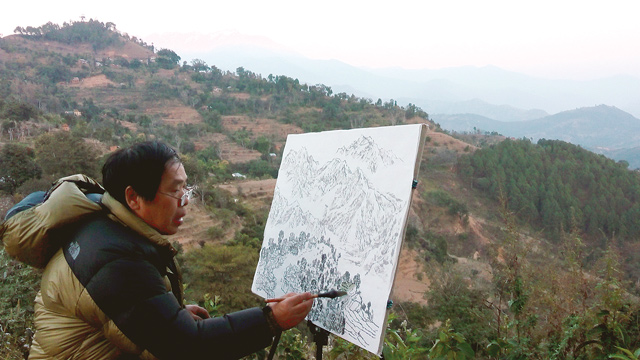
This past January, I decided to invite my parents over for a visit. My father, Zhao Jianqiu, is a famous artist in Chinese ink wash painting and very fond of depicting natural landscapes and folk architecture. I was nervous but sure that he would find Nepal interesting.
The first morning we had breakfast at a rooftop restaurant in Thamel from where we could see the geographic outline of the Kathmandu Valley. The fog was thick and mountains invisible, but my father was intrigued by the varied forms of low concrete buildings in the city. He was amused by the flocks of crows, which are inauspicious birds in China. I explained that although they are also associated with death in Nepal, people revere them during a special festival.
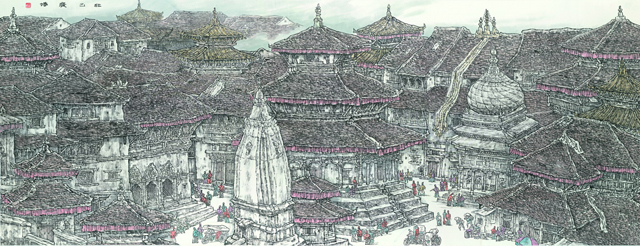
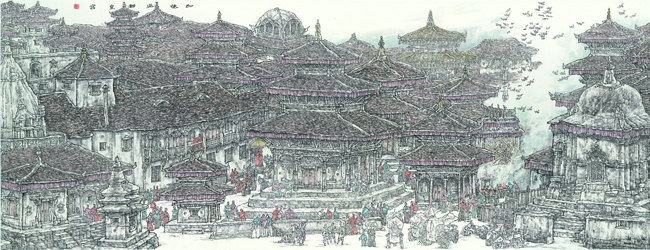
Basantapur Darbar Square
My parents' first encounter with the city was during a walk from Thamel to Basantapur through Jyatha, the same route I took on my first day in Kathmandu. The bustling market and crowded alleys reminded my parents of their youth in the Dongting Lake region of China. Upon reaching Basantapur, my father immediately set up his tools to paint the rather obscure Kotilingeswor Mahadev Temple next to Taleju. He must have been experimenting with the new subject matter and therefore did not choose the more grandiose temples.
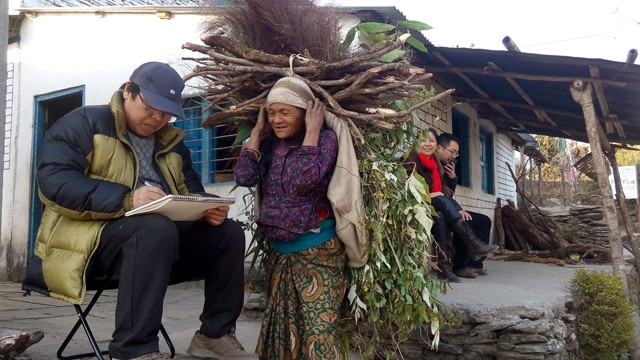
The Chinese brush-strokes and ink wash created an image that was completely different from the common oil paintings that I saw in Thamel every day, and I was glad to have brought my father to Nepal. My father was impressed by Patan Darbar and Pashupatinath, and complained incessantly that he didn’t have time to find the best angle from which to paint. Bungamati residents were intrigued when he moved the location of the stupas on his canvas for a better composition, and he entertained villagers in Panauti as he bantered with the women knitting on straw mattresses.
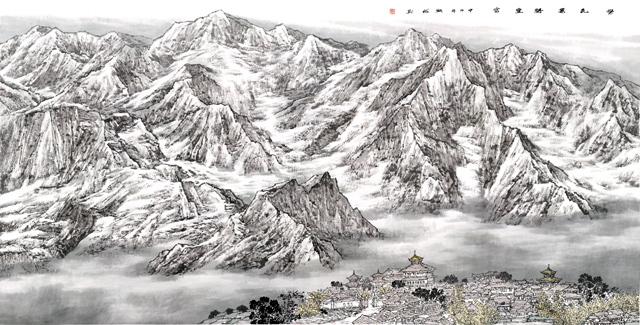
Nuwakot Darbar
We travelled to Kakani, where my parents had a glimpse of the Himalayan Range before heading down to Nuwakot Darbar. We stayed at the idyllic Famous Farm inn where we enjoyed superb hospitality and delicious organic food. The views were clear enough to observe both the golden sunset over Ganesh Himal and the dreamy morning mist shrouding the Trisuli valley.
In Pokhara, Machapuchre welcomed us every morning and we walked from hilltop to hilltop looking for the the best view. My father was enthralled by the ingenuity and playful designs of the village houses, and he lovingly drew the stone-slab adobe houses shadowed under the snowy peaks, and included our jeep in the painting as an homage to its contribution.
My parents returned to Nepal in April, and my father rode rickshaws everyday between Thamel and Basantapur painting non-stop from dawn to dusk. He became friends with the palace guards and rickshaw drivers, and later painted two pieces in their honour. My parents left a week before the earthquake struck.
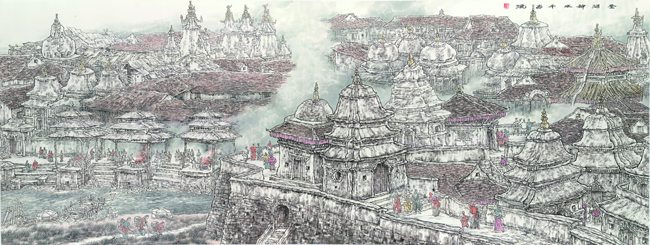
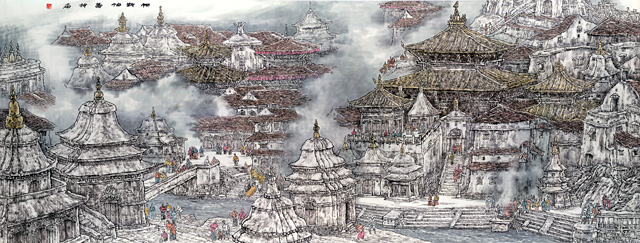
Pashupatinath temple
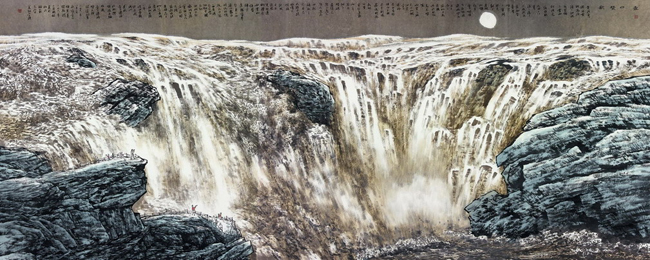
Shocked by the news of damage to the places he had visited, my father worked furiously in his studio to finish the panoramas of Pashupatinath and the Darbars of Basantapur, Patan and Bhaktapur. He also refined a new approach to draw the Himals and created monumental works of the mountains and human residences. His Nepal works have won the appreciation of art critics in both Nepal and China, and will be exhibited in October and November in Kathmandu and Beijing.
Justin Zhao is with the Beijing Centre for Chinese Studies, and visits Nepal frequently.
ZHAO JIANQIU
Celebrating the Trans-Himalayan Bond: An exhibition of Chinese Brush Paintings on Nepal and China
October 11-18
Nepal Art Council, Babar Mahal, Kathmandu
November 8-20
National Museum of China, Beijing
Trans-Himalayan art
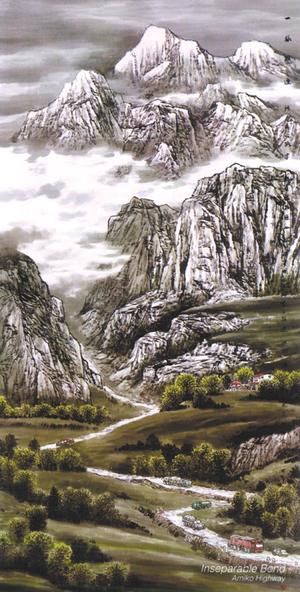
The exhibition ‘Celebrating the Trans-Himalayan Bond: An Exhibition of Chinese Brush Paintings on Nepal and China’ by Zhao Jianqui marks the 60th anniversary of Sino-Nepal diplomatic relations. The historic ties between China and Nepal go back to the 4th century when monks like Faxian (337- 422) and Xuanzang (602-664) made their way to Nepal, and recorded their travels.