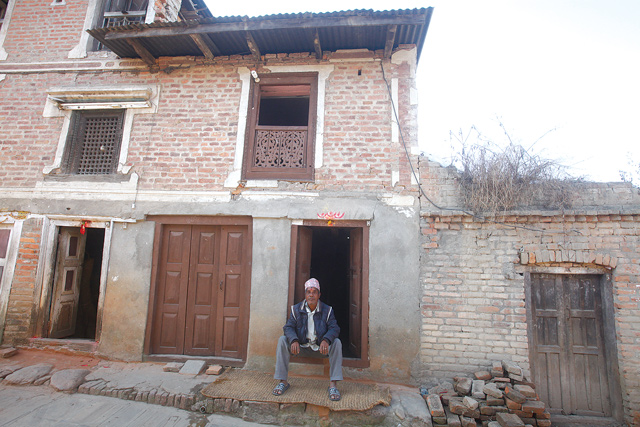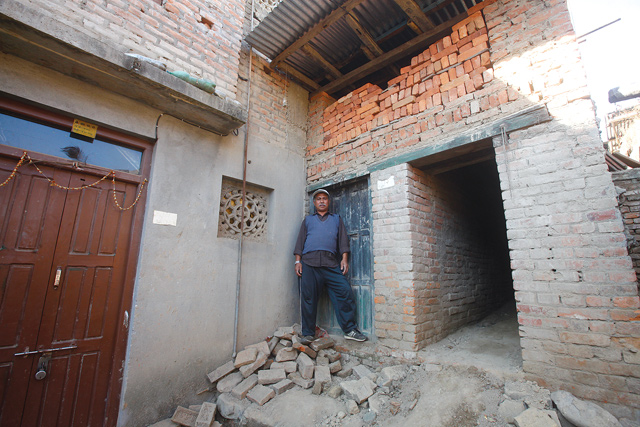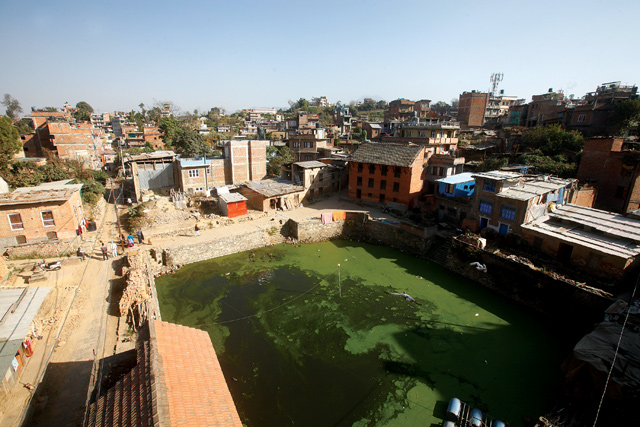
On a recent Saturday afternoon, 75-year-old Buddha Bahadur Shrestha was basking in the weak winter sun in front of his house in Bungamati, the town on the southern fringes of the Valley that was largely destroyed in last year’s earthquake.
Shrestha’s home lies in Baha Chhen and is one of the oldest houses in the town built with traditional brickwork, and its upper storey was badly damaged in the quake. He would like to rebuild, but says: “I have yet to receive the Rs 50,000 first instalment grant, but even that is not enough for the repairs.”
As elsewhere in historic parts of Kathmandu Valley, brick and mud mortar buildings and many ancient temples tumbled in the earthquake while adjoining concrete blocks suffered no damage. This has convinced many residents that concrete is safer, and conservationists fear that this will erode the traditional skyline of towns like Bungamati.
Krishna Shakya and his wife run a handicraft shop near Dev Pukhu and live in a temporary shelter after their clan home was completely destroyed. Because of the joint ownership, and required approvals from the municipality, the family has not been able to rebuild it in its traditional style. Far from being able to afford to reconstruct their ancestral home, the Shakyas have not received any of the compensation money, and neither have their neighbours.
Bekha Ratna Shakya would like to rebuild his damaged home in the traditional style, but says he could not afford it and built a concrete structure. “If given the finance I would like to build back in the old way,” he says.
A poster announcing the government’s launch of reconstruction in Bungamati last year lies discarded at the entrance to the town, and despite being so close to the capital much of it is still in ruins with many living in tin huts.
But Bungamati still clings to its old way of life, it’s residents still practicing the unique blend of rural-urban that used to be characteristic of the Valley’s kingdoms. Many families still follow their traditional occupations, and here it is mainly wood carving. The traditional spaces play an important role in Bungamati’s cultural and economic life.
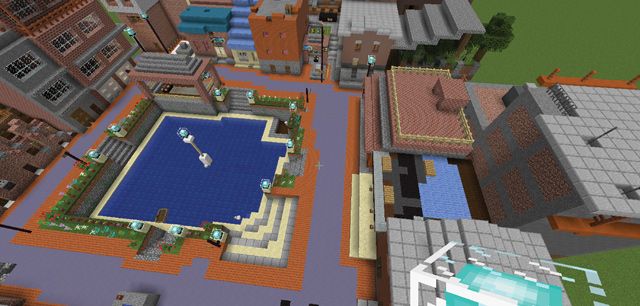
Padma Sundar Joshi of the United Nations Human Settlements Programme (UN-Habitat) has been trying to restore Bungamati’s public spaces in the traditional style, and also to build awareness among locals that it is important to rebuild preserving traditional facades.
“We took Bungamati residents to Patan to show them old buildings to change their perception that restoring traditional buildings is more expensive, or that concrete structures are safer,” Joshi explained.