
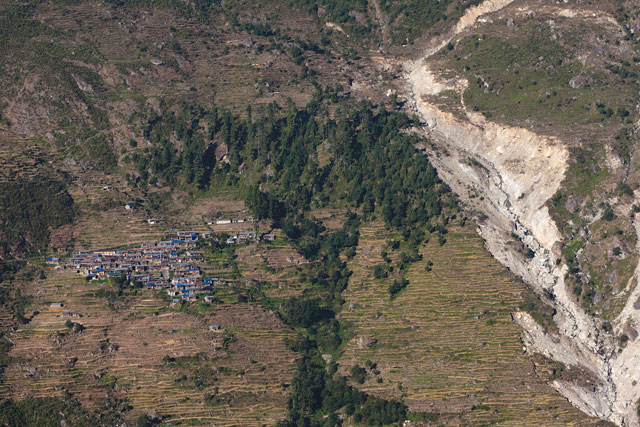
After a 7.8 magnitude earthquake flattened his house, Muku Tamang, a 35-year-old farmer from the remote Sertung village of northern Dhading district, built a temporary shelter with a tarpaulin sheet dropped by a helicopter.
Tamang considered himself lucky because all of his five family members survived the earthquake that killed 13 people in Sertung alone. “I thought the earthquake just destroyed my house, and I was certain I would rebuild it sooner than later,” he says.
But the earthquake turned out to be just the beginning of his hardships.
Monsoon rains have started triggering landslides on the unstable slopes, burying cropped terraces and houses that had withstood the jolt. Tamang lost most of his farm in a landslide on 15 June.
“There is no way relief supplies would reach my village, so we decided to walk down,” he says. “I was hoping I could feed my family with maize and potatoes that grew on my field but the landslide left me with nothing.”
Tamang’s wife and three children joined an exodus of people displaced by the earthquake and ensuing landslides. They walked down for two days, finally boarded a bus and arrived at the district capital of Dhading Besi.
According to Dhading CDO Basudev Ghimire, villages in Sertung, Tiplung, Jhaplang, Ri and Lapa are threatened by landslides and need urgent evacuation. More than 550 people from 60 families from northern Dhading have arrived and are living in a tented settlement outside town to wait out the rains.
“Saving people from landslides in this monsoon is a huge challenge,” he says.
Tek Tamang, 29, also left Sertung because it was impossible to live there: “The earthquake and landslides destroyed not only our houses but also schools, health posts, water taps and water mills. The government must show us a safe place to relocate. Life is not easy here, the tents leak and the wind blows them off.”
Landslides are now emerging as the next big disaster in the 15 mountain districts worst affected by the earthquakes of 25 April and 12 May. International Centre for Integrated Mountain Development (ICIMOD) says the earthquakes have caused more than 3,000 landslides in central Nepal.
Apart from Dhading, districts like Sindhupalchok, Rasuwa, Gorkha, Dolakha and Kavre are at a high risk of landslides this monsoon. Thousands of families have abandoned their villages and have moved to wherever they can live safely.