
Nepal’s disaster isn’t over yet: it is just moving into the next phase.
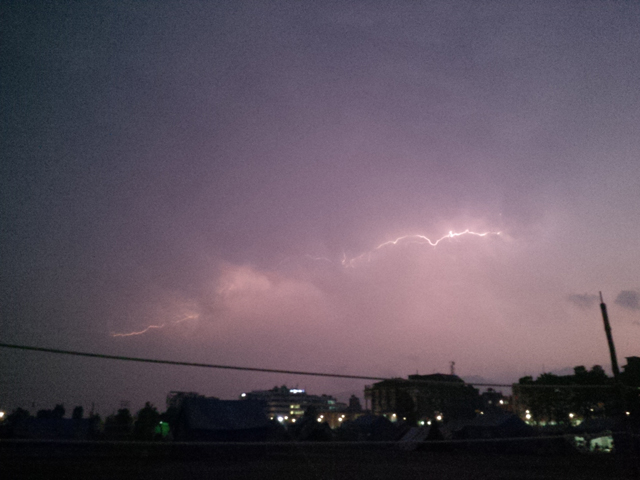 A lightning flash is seen over a shelter in Kathmandu. Photo: Kunda Dixit
If there were still doubts about just how challenging the rainy season will be to compound the misery unleashed by the earthquakes, the landslide on the Kali Gandaki in Myagdi district last week was a timely reminder. If the entire side of a mountain could fall into a major Himalayan river, blocking it for 16 hours even though it was 120km from the epicentre and there were no big aftershocks at the time, imagine what it will be like when the rains arrive.
Even as we write this on Tuesday night, a M5 aftershock with an epicentre in Rasuwa is rocking central Nepal. The mountains are still trembling, the slopes are unstable – all that is needed is water and gravity to complete the vicious cycle. Within a month, the monsoon will arrive unleashing the rains on these crumbly slopes. Central Nepal gets between 1,500-3,000mm of annual precipitation in an average year, and 85 per cent of that usually falls in the four months between June-September.
Villages and settlements in the direct path of existing landslides need to be urgently relocated. For Rasuwa, Sindhupalchok and Dolakha this means just about every other market town along the highways that follow rivers. Although many have already left, it will be a gigantic task to move the others to safer places.
Nepal’s disaster isn’t over yet: it is just moving into the next phase. The government’s relief mechanism needs to go back into rescue mode. It needs to be on high alert to detect, assess, evacuate and organise the release of water impounded by landslide lakes. Given the shortage of helicopters and low cloud cover, this is going to severely test rapid response teams. Information has to be prompt and credible so there is no crying wolf, and spreading unnecessary panic downstream. In a sense, we are looking at multiple Kali Gandakis and slope failures on the scale of the Jure disaster last year.
We were lucky this time that the shaking in the 25 April quake and the 12 May aftershock were not severe enough to affect the moraine dams of numerous glacial lakes in central Nepal and Tibet. These feed into all three Bhote Kosis as well as other glacier-fed rivers originating in Nepal. In a year with more-than-average winter and spring snowfall, the lake levels are high and moraines have been weakened, the monsoon could compound the threat. An early warning system that coordinates between China, various Nepali line ministries and the security forces need to be put quickly into place for this monsoon and beyond. We may not always be as lucky as we were in Myagdi last week because the Kali Gandaki landslide lake emptied itself out gradually.