
In the political roller coaster ride we are all in, many of us haven’t fully taken in the implications of the results of the 2011 census for the new constitution. Last week’s Dasain holidays bore out some of its findings. Kathmandu’s registered population in the census was 2,517,023, with a floating population of about 1 million which roughly corresponded with the police’s estimate of the numbers that left Kathmandu for the holidays.
The main flaw of the census, as was pointed out when the results were announced last year, was that it did not count the absentee population away for more than six months. This cutoff essentially disqualified from the total the estimated 4 million Nepalis who are away at any given time. By putting Nepal’s population at 28.412 million, we undercounted the total by 1.9 million according to the Census Bureau. Of these, 1.1 million were from the hills and 800,000 from the Tarai, 1.7 million were men and 200,000 women. But even the undercount is an undercount because many Nepalis working long-term in India (estimated at 2 million) were most likely excluded in 2011. What this means is that all extrapolations on gender ratio, annual population growth rate, or the proportion of population in the Tarai are probably off by a wide margin.
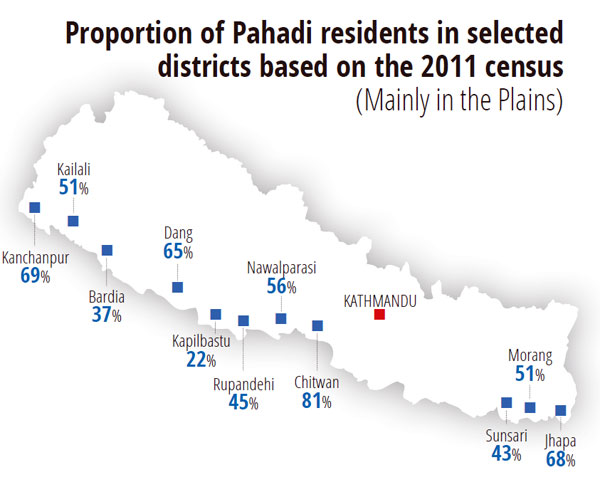
For instance, based on a total population calculation of 28.412 million, we concluded in this space two years ago that Nepal had defused its population bomb by bringing down the population growth rate in the past decade to 1.3 per annum. Of the missing population in the census most are men, which means females do not outnumber males as the census results, at first, seemed to infer. Also, since most of the absentee population is from the hills, the actual Tarai population in 2011 was still slightly less than the hills. If Nepal’s actual population (counting migrant workers) was nearer to 32 million in 2011, then the conclusions need to be revised.
The fertility rate does seem to have fallen. And the ongoing exodus from the midhills means that some districts have been depopulated by up to one-third compared to 10 years ago. Also, the youth bulge would be even wider if the young absentee population is counted.