
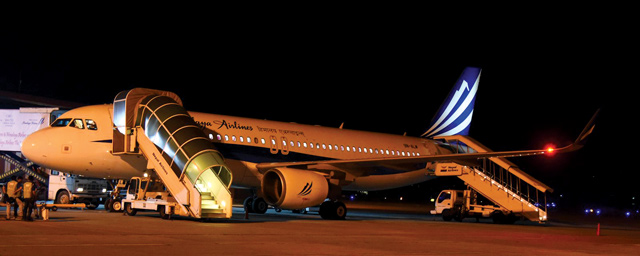
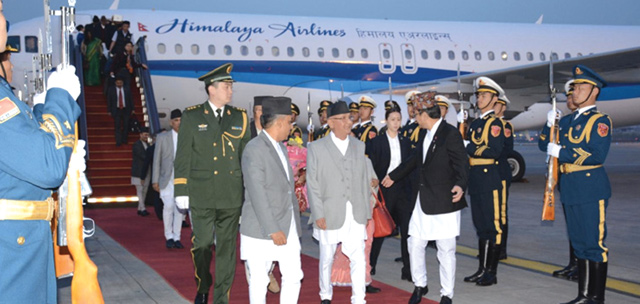
When Himalaya Airlines, a Nepal-China joint venture, operated its first flight to Beijing in March 2016 with Prime Minister KP Oli on board (pictured, below), there was hope that Nepal would finally be struck off the European safety blacklist.
However, the European Union (EU) Air Safety List was updated early this month, and Nepal is still on it.
The Civil Aviation Authority of Nepal (CAAN) had seen Himalaya Airlines as an opportunity to demonstrate that Nepal meets the International Civil Aviation Organisation (ICAO) standards. Indeed, there was an expectation that a new airline with new Airbus 320s would set new safety standards for Nepal.
But Himalaya Airlines seems to have run into considerable turbulence soon after takeoff. There have been resignations or termination of key technical staff, and accusations that it is ignoring safety measures.
Himalaya Airlines asked its Director of Flight Operations, Gabriele Ascenzo, to resign in November, apparently after he criticised management for not following safety guidelines. A veteran pilot with expertise in airline safety, Ascenzo had been hired by the Airlines to ensure compliance with ICAO procedures.
Vijay Shrestha, Vice President of Himalaya Airlines, declined to comment on Ascenzo’s exit, saying only that his contract was “terminated by mutual agreement”.
Ascenzo had helped establish Himalaya’s Flight Operations Department, hiring flight managers and pilots, and preparing flight training standards. At least six other pilots and one performance engineer have also quit the airline in the past month. Some of them were sacked and have filed a case at the labour court in Kathmandu, accusing the airline of violating employment contracts.
Tension between management and staff grew when Zhao Guo Quiang of Tibet Airlines— which holds 49% share in Himalaya Airlines (with 51% share owned by Nepal’s Yeti World Investment Pvt. Ltd.) — became the new president three months ago. He was also declared the Accountable Manager, but Ascenzo argued that the appointments to the posts vital for air safety were subject to CAAN’s approval.
Ascenzo paid the price for drawing the company’s attention to ICAO requirements. He did not receive his salary for two months, and his contract was finally terminated. It has been learned that the airline sacked him on the ground that he was above 65 — the age limit for pilots. But he had crossed that limit a year before joining Himalaya Airlines, and was not a crew member.
After Zhao’s arrival, the airline also slashed allowances for pilots, who were already angry over not being given insurance coverage for medical expenses and loss of licence.
After several pilots quit, the airline apparently cancelled the leave of some of the remaining pilots. Some disgruntled staffers also said the airline was reducing the number of hours that co-pilots need to fly the planes in order to be promoted as pilots.