When a draft copy of the 2011 census report was shown to Nepal’s leading demographer, he was stunned. He thought there had been a mistake.
“Some of the figures were so surprising I asked the statisticians to check the whole report again,” Yagya Bahadur Karki, a former member of the National Planning Commission recalls.
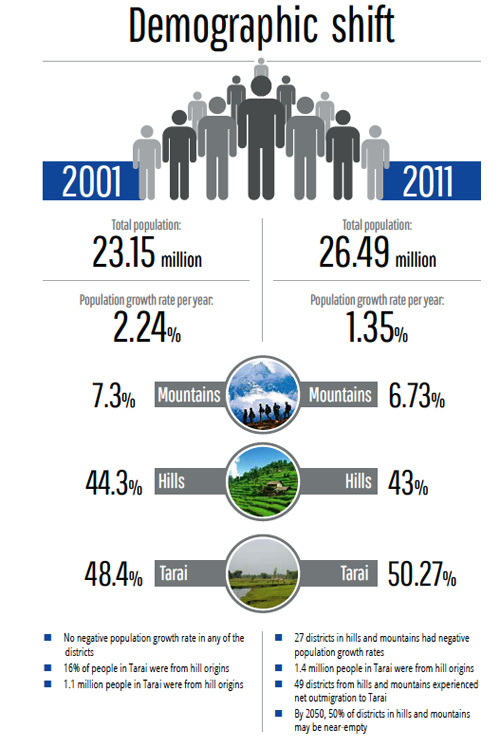
The Central Bureau of Statistics eventually published the census report, which gave a glimpse of the tremendous movement of people from hills to plains, from rural to urban areas and migrations abroad for work. The figures have huge implications for public policy, politics and, in particular, appear to be at the root of the current unrest in the Madhes.
“The result of the 2011 census are more important than ever because they suggest that Nepal has seen tremendous demographic transformation in the last decade,” says Karki.
The most significant aspect of these changes, and one that appears to be fuelling protests in the Tarai, is the accelerated transmigration of hill settlers down to the plains. The number of hill Bahuns, Chhetris, Limbus and other ethnic groups as a proportion of Tarai’s population has risen sharply in the past decade. In 2001, lifetime migrants in the Tarai, who include people not born there, numbered 1.1 million, and ten years later, that figure had increased to 1.4 million. “This increases the importance of assimilation and communal harmony between different ethnic groups,” says Pitamber Sharma, former Vice-Chairman of the National Planning Commission who advocated including Jhapa in the Madhes Province 2. He says the current boundaries ignore the case for integration of hill and plains populations. “The demand for proportional representation based on population is a justified one because of the increasing population of the Tarai,” he explains.
The other dramatic demographic shift is in the population growth rate, which hovered at slightly above 2 per cent for the early 2000s but dropped to a startling 1.35 per cent in 2011. Some took this to mean that Nepal had defused the population bomb, while others argued that the figure is misleading because the census excluded Nepalis who had been living abroad for more than six months.
But demographer Karki says that even if we include the absentee population in the calculations as was done in 1991, Nepal’s population growth rate has still plummeted.