
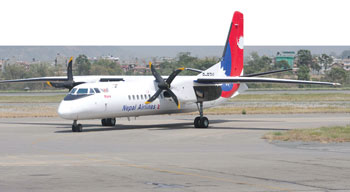
When the airline finally added a new aircraft (pic, right) to its fleet last week for the first time in 27 years, there were cynical comments in media and social networking sites about airline managers thinking about kickbacks. The poor condition of our country and its flag carrier have nothing to do with Nepal or Nepal Airlines. The blame goes to greedy and selfish politicians who put their own interest ahead of the interest of the country, its people and its flag carrier. The tragedy is that we have learnt nothing from the mistakes of the 1990s that led to the deterioration of the airline.
For us loyal employees, however, the induction of eight new aircrafts in the next two years has restored hope and confidence that we can rebuild a once proud company. But we are still wary about political interference and lack of transparency that may once more stymie efforts to run an airline that all Nepalis will be honoured to call our own.
Unfortunately, the sense of relief about the new plane did not last long as private operators saw the drastically low promotional fares offered by Nepal Airlines on trunk routes as a threat. There has been intense lobbying to question the safety record of the MA60, and to spread rumours that this was the real reason the EU put Nepal on the black list.
The Xian MA60s were originally intended for the Royal Nepal Army during the conflict years in a deal backed by the palace. Because the advance had already been paid, in 2010 the government renegotiated a ‘buy-one-get-one free’ deal so that one of the two MA60s and two of the four Y-12s will be grants.
The Nepal Airlines management was attacked for pushing a plane that had a questionable safety record, and the opposition was so fierce that negotiations nearly collapsed. Managing Director Madan Kharel, however, persevered and overcame intense pressures to get the contract back on track.
As a pilot myself, I can state categorically that we don’t buy a plane unless it is safe and its airworthiness is beyond doubt. Having visited the Xian factory in Shanxi and inspected their manufacturing process, I can vouch for the fact that both the MA60 and the Y-12 meet international aviation safety standards. The twin-engined turboprop is based on the Russian designed An-24 to land in rough and short airstrips with minimal ground support. Its two engines are Canadian-made Pratt & Whitney PW127J turboprops, and it is equipped with Rockwell Collins cockpit avionics from the US.
