
 MIN RATNA BAJRACHARYA |
Tourist arrival by air between January to June was up by 20 per cent from 2011, and is expected to total 800,000 this year. The number of overseas workers will hit 450,000 this year, with more than 200,000 going to Qatar and Malaysia alone. Travel and tourism contributed four per cent of total GDP in 2011, and this is forecast to rise to 4.7 per cent in 2012, mainly because of the growth in Nepal's aviation sector.
Since Nepal has only one international air gateway, streamlining procedures at the airport, making it attractive for new international airlines to fly to Nepal, as well as removing infrastructure bottlenecks should be government priorities. But it doesn't seem to be.
Landing and navigation charges in Kathmandu are 30 per cent higher than other airports in the region, but the facilities offered are not up to par. Ground handling is largely a monopoly of Nepal Airlines, and international operators say they are forced to use its expensive and shoddy service. The international airport is a national disgrace, with mismanagement, rude staff, and huge queues. Frequent media exposes have made the airport synonymous with corruption.
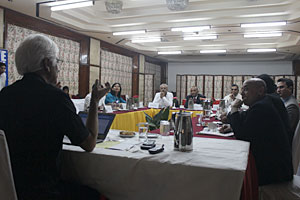 PICS: TRISHNA RANA HIGH FLIERS: Heads of airline companies and travel agencies discuss the problems facing Nepal's aviation industry and ways forward at a roundtable organised by Himalmedia on Tuesday afternoon. |
With the mirage of a new international airport receding, aviation experts say the economic importance of Kathmandu airport will only increase in the years ahead. Representatives of international airlines based in Kathmandu say they see tremendous potential for growth if some of the structural challenges to do with safety and infrastructure can be dealt with.
"The market is not growing very rapidly, but it is relatively good, there is enough potential for organic growth," says Ramdas Shivram of Qatar Airways, which carries the highest volume of passengers to Kathmandu with four daily flights from Doha. This week, it started using RNP-AR, a new navigation system to make precision approaches that will reduce delays and diversions due to poor visibility at Kathmandu airport in winter, and ensure more safety. This project initiative is undertaken by the Civil Aviation Authority of Nepal (CAAN) in coordination with the Airbus Industrie subsidiary, Quovadis, and Qatar Airways.
Chantosh Srinilta, the manager of Thai International, which has been operating continuously to Kathmandu for 45 years, sees potential for even more growth in tourist traffic to Nepal. "We would like to share our experiences to promote Nepal through roadshows and travel marts to increase tourist traffic," Srinilta said at the 'Nepal By Air' roundtable on the airline industry on Tuesday organised by Nepali Times.
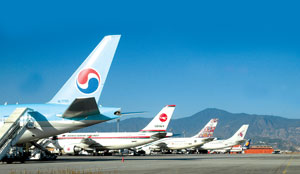
There are now 28 international airlines connecting Kathmandu to rest of the world, and two new airlines, including Turkish, are expected to start operations soon. However, Kathmandu is running out of landing slots especially in winter when the airport is open only from midday, as the fog lifts, till midnight.
 |
Samir Chada, the representative of Jet Airways which operates two daily flights to Delhi and one to Mumbai, agrees that there are bottlenecks for expansion. "There are 28 airlines already here, so obviously there are huge opportunities for growth," Chada says, "but if the infrastructure, costs, and pricing issues can be resolved we can see even more flights."
Renji Thomas of Gulf Air agrees, and says his airline would add to the 14 flights a week it operates if the charges and taxes were reduced. "Even though business has grown, the bottom line is in the red because of costs," Thomas explained.
 |
For this there has to be paradigm shift in aviation policy, and a strategy to boost passengers. Joy Dewan of Zenith Travels, which handles Spicejet and Bahrain Air in Kathmandu, agrees. A major concern for the government should be how to attract more carriers and retain the existing ones with consistent policies and rational pricing, he says.
Airlines have been paying taxes even on the taxes of ticket sales, and are lobbying to make it fare-based. "The airlines need to justify their operations in Nepal, we should not be pricing ourselves out of the market," Dewan told the 'Nepal By Air' roundtable.
| WHAT'S WRONG | HOW TO FIX IT |
| No more landing slots | Allow 24-hour operation |
| Traffic congestion | Upgrade taxiways and apron |
| Weather delays | Improve navigation system |
| Expensive ground handling | Allow private providers |
| Expensive landing charges | Reduce to international norms |
| Poor condition of terminal | Improve, privatise, management |
| Immigration and security lines | Train and streamline |
Airlines are not satisfied with the price and quality of ground handling (which includes check-in, baggage delivery, bus ferry from terminal to plane) that Nepal Airlines provides to most operators. But the carrier is reluctant to let go because ground handling charges alone make up 18 per cent of the annual revenue of Nepal Airlines. There is a push to deregulate ground handling, allow competition, bring down costs, and improve service. However, an initiative to hand over the management of Kathmandu airport to an Indian company was put off because of a nationalist hue and cry.
"Cost is a factor, but for us it is not as important as the quality of ground handling, the service level has to go up," says Pawana Shrestha of Etihad Airways.
Thai, which has always done its own ground services, is facing a KFC-type union issue, and says the government should revise the labour act and implement it strictly. Most airline operators say that the authorities tend to see airlines as a cash cow, and don't realise that they have to work on very slim margins.
 |
Nepal's national airline is plagued by the same problems the airport is. Its share of international traffic has now gone down to five per cent because of government interference in its plans to increase and modernise its fleet. "The country's economic growth is tied up with the state of its national airline," admits Nepal Airlines' Commercial Director, Madan Kharel, "we have to regain the position of being the main carrier of tourists and Nepali workers."
Travel trade executives say improving the management of the state-run airport and airline, and making them more efficient would be a big boost to Nepal's economy by making air travel to and from Nepal easier.
BK Singh of Everest Express which handles Silk Air recounts what passengers often say when they arrive here: "I know I have landed in Kathmandu airport, I can smell it."
Read also:
Jet set go
A safer sky, VIJAY LAMA
An airline captain suggests immediate steps to minimise the dangers of flying in Nepal
Disastrous disaster management, ANDY JOSHY
Post-accident crisis management is almost non-existent in Nepal
Destination Dasain
With 28 international airlines operating in Nepal, choices are large for customers this Dasain