
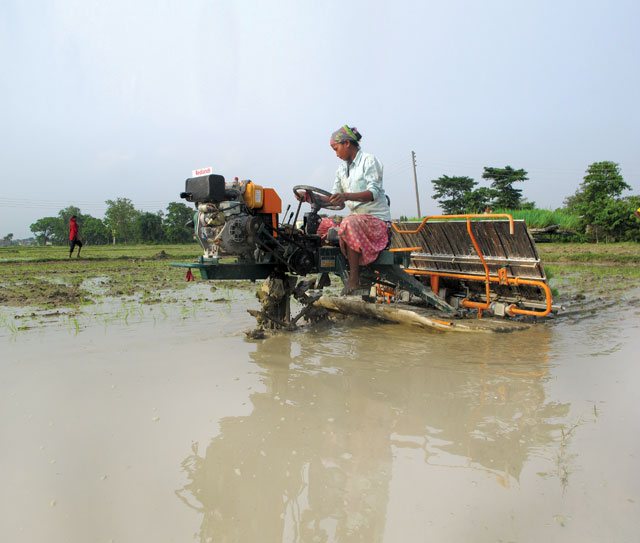
Eighty per cent of Nepalis live off the farm. Agri-culture accounts for one-third of Nepal’s GDP, but the country has turned from a net exporter to importer of rice.
Investment in irrigation, high-yield seeds, mechanisation, and pricing incentives can easily boost rice production and create jobs on the farm for Nepalis. All it needs is for agriculture to have more government priority than it currently receives.
The food balance sheet for 2015-16 shows a deficit of 1,106,892 tons in rice as production plummeted to 4.3 million tons. Things are looking better this year as harvests are up by 21 per cent to 5.23 million tons because of a good monsoon. The Prime Minister Agriculture Modernisation Project, if properly implemented, could decrease dependency on food imports, especially rice from India.
Since most farms are rain-fed, the single most important contribution to boosting productivity would be irrigation. Only 1.3 hectares of farms in Nepal get year-round irrigation – 18 per cent of the total arable land. Monsoon rice is planted in 1,450,000 hectares, while only 112,000 hectares grow spring rice because of the lack of irrigation.
Says Mukunda Bhusal, Crop Production Officer at Department of Agriculture: “Rice imports will go down if we can increase the production of spring rice, but that needs irrigation.”
However, Nepalis are moving away from the land or migrating overseas for work as soon as they leave school. Booming real estate prices and urban expansion have reduced total cultivated area. And cheap rice from India does not make it worthwhile for Nepali farmers to grow paddy.
“The other way is to change the food habits of Nepalis and replace rice with other grains,” says Bhusal. But that may be easier said than done in a country where “Have you eaten rice today?” is a form of greeting, and people in the mountains are turning to rice from traditional millet and buckwheat.