
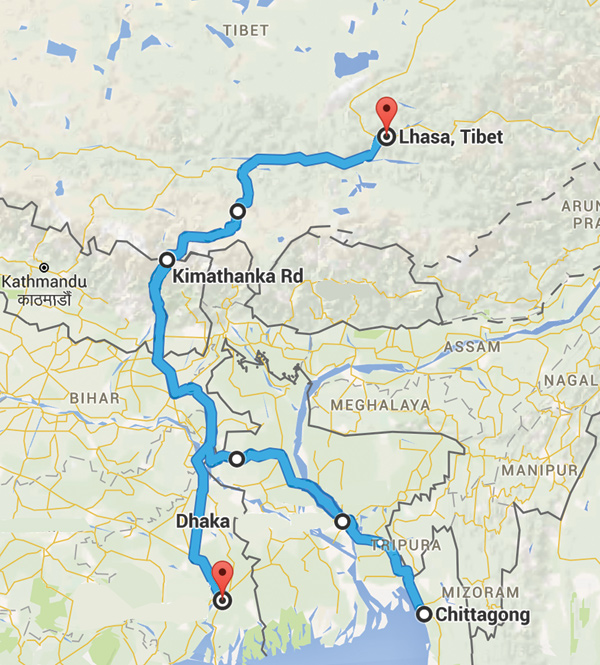
The acronyms that have invaded the diplomatic and Track Two discourse hold the promise of converting ‘connectivity’ from a goal to reality. BIMSTEC, BCIM and BBIN represent efforts to link the northeastern quadrant of South Asia through transport, energy grids, services and seamless commerce, all of which would lead towards economic growth and social justice.
While some may be wary or skeptical of the bilateral steps taken by Nepal recently with India and China, they could be a trigger for regional commerce. Despite geopolitical and practical obstacles, we may finally be seeing the energising of societies through efficiencies and economies of scale made possible by bilateral, trilateral and multilateral trade in goods and services.
BIMSTEC is 20 years old, and was evolving like the ponderous SAARC, but now it has new energy with the democratic evolution of Myanmar, and the grouping has just opened its secretariat in Dhaka, the city that would be fulcrum to this particular sub-region. BIMSTEC holds the prospect of linking Bangladesh, Bhutan, India, Myanmar and Nepal, but first we need the tension between Kathmandu and New Delhi to subside.
Started as the Kunming Initiative, BCIM is an effort to bring China (mostly Yunnan) into collaboration with Bangladesh, China, India and Myanmar. A look at the map shows why this is geographically sensible: Beijing would find it more convenient to connect to the sea via Chittagong than reaching all the way to Gwadar in Pakistan.
The BBIN motor vehicle agreement (for passenger, personal and cargo transfer) has unexpectedly emerged these past two years as a possible catalyst. It would boost commerce between Bangladesh, Bhutan, India and Nepal, and also pave the way for future BIMSTEC-wide and SAARC-wide connections.
The breakaway moment came when Indian PM Narendra Modi told SAARC’s Kathmandu summit in November 2014 that sub-regionalism was the answer if all eight member countries could not agree on strategy and action: “either all of us or some of us”. Pakistan had reservations on the SAARC Motor Vehicle Agreement then under negotiation, and, under India’s urging, the other countries moved with unexpected speed. The BBIN agreement was signed in Thimphu in June 2015.
The BBIN agreement allows for protocols to provide unhindered road and rail transport across the borders of the four countries. Prime Minister KP Oli deserves credit for having created an enabling environment for BBIN with his trips to New Delhi and Beijing in February and March. In India, besides inaugurating the Dhalkebar-Muzaffarpur 400 KVA line, which allows two-way transfer of power, New Delhi agreed to rationalise Nepal-to-Bangladesh transit for both truck and rail transport.