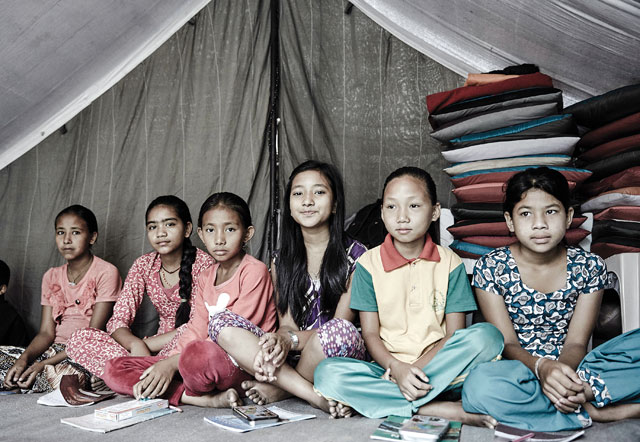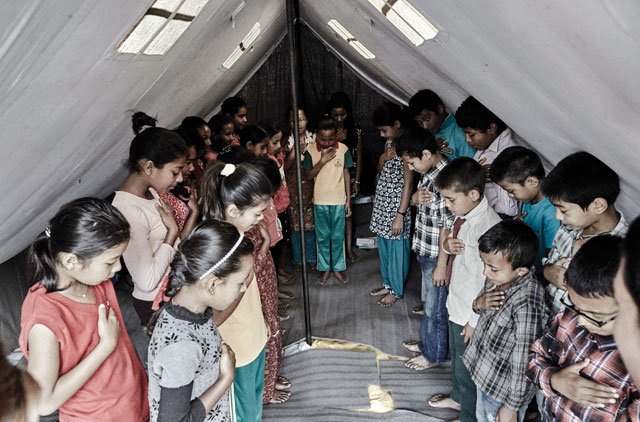
"SAYAUN THUNGA": Children in Barabise of Sindhupalchok sing the national anthem and attend class in a tent after their school building was destroyed in the 25 April earthquake. Photos: JAN MØLLER HANSEN
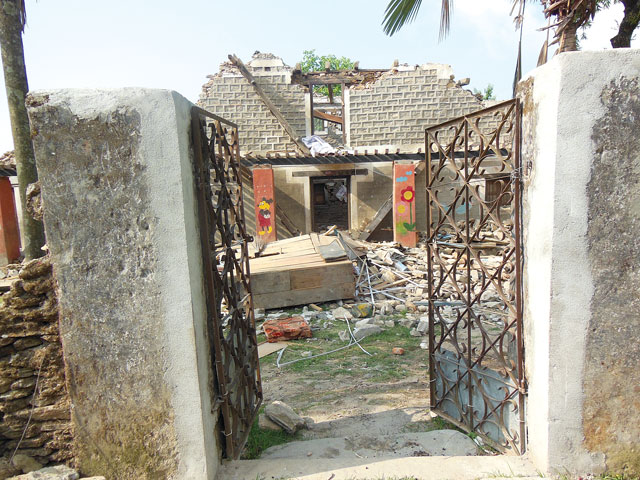
A Mickey Mouse and a flower painted on shattered pillars are a reminder of happier times here at the Raj Kaleshwor School in Dolakha Bazar. A wooden staircase leading to the second floor is dangling precariously – there is no second floor. Desks and benches are crushed and scattered. The gate is the only structure still standing in a school with 250 students (pic).
All 363 schools and 1,200 classrooms in Dolakha district were brought down in the 25 April earthquake and the 12 May aftershock. Many students would have been killed if the earthquake had struck on a weekday, or if children had gone back to school when the aftershock came.
“Schools in northern Dolakha are the worst affected, and although we have put up temporary learning centres they are very vulnerable to landslides because the rains have started,” said Dolakha’s Assistant District Education Officer Madhav Sharma. “We are now working to make the temporary classrooms sturdier.”
Across the 15 most-affected districts, 30,145 classrooms were completely destroyed and most of these were in government schools. The earthquake killed 618 students and 45 teachers, and an estimated 1.5 million students were affected.
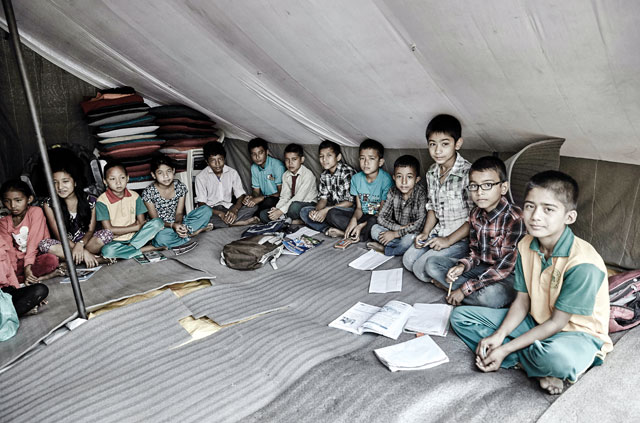
It has been two weeks since the schools reopened, and most of them conducted extracurricular activities to put students at ease. Even teachers needed psychosocial counseling, and 416 teachers in Dolakha were trained in post-disaster instruction in classrooms.
As in Dolakha, many schools in Kathmandu Valley also served as shelters for families fleeing their unsafe homes. Adarsha Kanya School in Patan housed more than 500 people for a month after the quake.
Teacher Muna Kharel said, “We were trained to make students get over their fears and we have a few students who lost their family members who couldn’t even speak in the first few days, but now with counseling they are starting to cope and move on.”
Uniformed students in temporary bamboo and thatch classrooms seemed engaged in class activity and engrossed in chatting with friends after more than a month’s long break. Many, however, are still afraid of aftershocks. Ninth grader Srijana Senchuri lost her grandfather in the earthquake, and told us she can’t really focus on her studies.
“My favorite subject is math but these days whenever I try to study or concentrate I fear that there will be another shaking,” she said, “what if that happens again?”