 Read also:
- Switched on, Om Astha Rai
- Power Struggle, Editorial
- Mustering up energy to face the future, Om Astha Rai
- Be smart, go electric, Smriti Basnet
- Future power house of South Asia, Sujit Acharya
- Private sector lead in grid solar system
Nepal’s energy crisis spares no one: every organisation, from businesses and farms to schools and health clinics, struggles with it. Solar energy can be deployed more quickly than any other source to meet the country’s demand.
The Nepal government, in partnership with international donors, has made a commitment to diversify its energy mix, and provide incentives to kickstart the solar energy industry. Subsidy can be a very important tool for building a thriving solar industry, and has been used successfully in other countries. However, if not planned well, subsidies can potentially damage the market.
For example, in Spain and Italy highly subsidised solar programs were unsustainable due to high costs to taxpayers and were abruptly ended. But in Bangladesh 3.5 million solar home systems were deployed from 2002-2015 with a minimal subsidy of 10 per cent.
The California Solar Initiative led to the installation of over 2,500 MW of solar from 2007-2016. The majority of projects received financing, and did not require state-level subsidies.
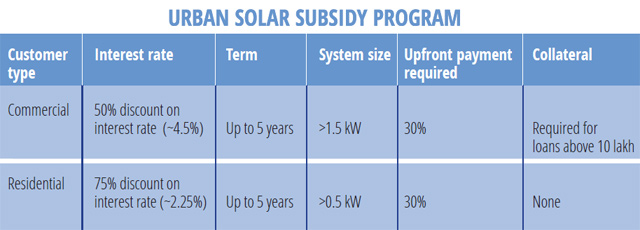
In Nepal the urban financing program provides very low interest rates for commercial and residential solar in Kathmandu and other urban areas.
A commercial customer that gets a 4.5% interest on a Rs 100,000 loan would end up paying just Rs 1,865 per month over five years. This is in addition to traditional upfront subsidies, such as a flat Rs 20,000 payment for solar systems at urban households and a 60% subsidy (up to Rs 500,000) for urban public health clinics and schools.