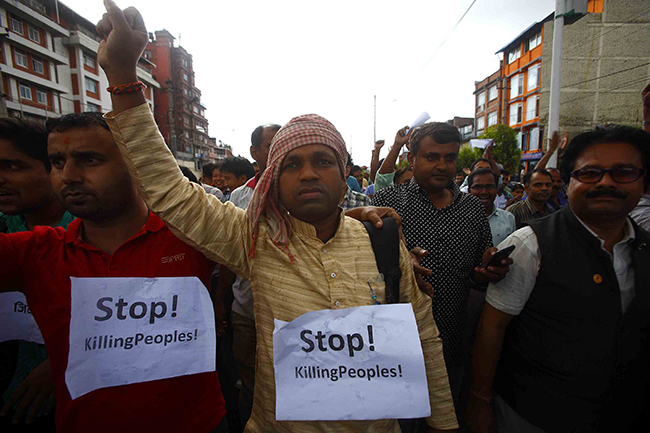
Madhesi groups protest against the new constitution in Kathmandu. Photo: Gopen Rai
New Delhi has demonstrated through strong-arm tactics its dissatisfaction over the provisions of the new constitution, and a section of Madhesi society has supported this cross-border solidarity.
The disgruntled Madhesi parties appear upbeat over the southern neighbour’s intervention on their behalf. Ashok Rai of the Federal Socialist Forum Nepal even went as far as to say last week that India’s pressure tactics on Nepal through a blockade was “welcome”.
However, in its pursuit of appeasing the Madhes, the southern neighbour has probably miscalculated. There are many here in India who think that New Delhi will now face an uphill task to regain the trust of a majority of Nepalis. Indeed, the move has squandered all the bilateral goodwill that had been built by Prime Minister Narendra Modi after his visit to Kathmandu last year. Even if it is a policy of ‘divide and rule’, it is hard to see how a communally unstable Nepal would be in India’s national interest.
To be sure, the Madhesis have time and again had to prove their Nepali credentials and loyalty to the Nepali state. So ingrained is the racism, that it has bred resentment in the Madhes, and this erupted when what was seen as a discriminatory constitution was promulgated. Now, the task of proving our ‘Nepalihood’ will be that much more difficult thanks to Indian intervention, supposedly on our behalf.
Yes, we Madhesis share a cultural affinity to the north Indian plains. However, this doesn’t mean Madhesis are beholden to India — neither Kathmandu nor New Delhi seem to have understood that. Madhesis may be regarded culturally as being close to India, but we are Nepalis through and through. A Madhesi Nepali in India, Qatar or Malaysia is regarded as a Nepali first.