

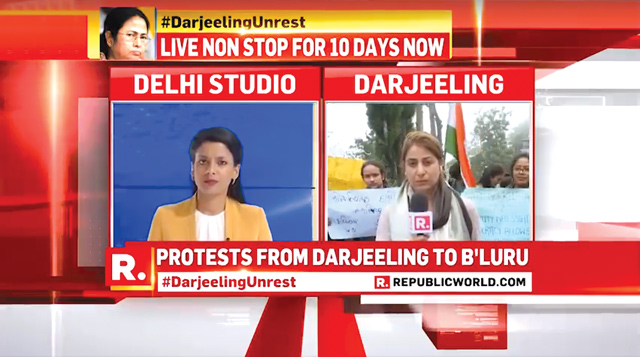
I was relating a bedtime story to our six-year-old son when my wife read an SMS on her phone: ‘Enough is enough. We want Gorkhaland now.’
Her outburst that followed startled us: “This was in the making for a long time. We are unhappy with the way things are. We look at the development that Sikkim has achieved and pity ourselves.”
My wife was born in Siliguri, a Tarai city of Darjeeling District adjoining Nepal. She went to school in various places in North India, so unlike most Indians from places other than the Hindi speaking belt of India, she speaks excellent Hindi. Till now, I had not imagined her as a passionate supporter of the Gorkhaland cause, seeing her always as someone with a strong sense of belonging to the idea of India. It took me some time to realise that she can be both at the same time.
India has been, right from the beginning, a complex political entity. In fact, many westerners predicted at independence in 1947 that India would not last a decade as a nation. It’s a striking success of the nation-building project that India has survived. Most ethno-nationalist movements have barely been able to carve out a space in the popular psyche.
The ‘Indian Nepali’ community, in its struggle to enter the core of Indian nationhood, has discarded its association with Nepal and heavily relied on creating an identity around the term Gorkha. Gorkhaland is the dream of a homeland for the ‘Gorkhas’: Indians of Nepali origin. The main argument is that statehood to the Darjeeling area will give them a distinctive identity, separate from those in Nepal.
The Darjeeling region became a part of Bengal by accident. In the early 19th century two British officers who were sent to the area to resolve a dispute between Sikkim and Nepal found the hill station suitable as an R&R base for British soldiers. Darjeeling had ‘home weather’ for the British, and they forced the King of Sikkim to cede the area to the East India Company in 1935. It was kept under the Bengal administration, and after India’s independence became part of the state of West Bengal.
Although the demand for the area to be administered separately from Bengal is more than a century old, the real struggle for Gorkhaland was the rallying point in 1986 for Subhash Ghisingh. The Darjeeling Gorkha Hill Council was finally established after two years and a loss of 1,200 lives. Ghisingh then ruled the hills for two decades, but the people got little out of it. Corruption was rampant and Darjeeling lagged behind Sikkim’s phenomenal progress.