
|
|
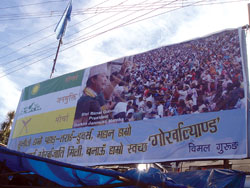
Gorkhaland is suddenly in the news again among India's close to 10 million Nepali-speakers. The new protests are against the Indian government's decision to introduce a bill giving the Subhas Ghising-led Gorkha National Liberation Front (GNLF) rights to self-governance under India's sixth schedule. The 'Gorkhalis' who are protesting want to establish a separate Gorkhaland by 2010.
The people of Darjeeling asked for a separate state in 1907 from the British. But even after a hundred years, this demand has still not been met. The 1986 uprising led by Subhas Ghising and his GNU culminated in a tripartite agreement between the West Bengal government, the central government and Ghising. Twelve hundred people lost their lives and the Indian government quelled the uprising only by creating a Gorkha Darjeeling Hill Council (GDHC) and making the GNLF Subhas Ghising its head.
Ghising's term ended in 2004 but there has been no re-election and he shows no signs of letting the chair go. There was supposed to be an election on 25 March 2005 but on 1 January 2005, Ghising demanded the scrapping of the Hill Council and merger with the sixth schedule of India's constitution. He also demanded the resignations of the 28-member council. Ghising was also appointed acting administrator by the Bengal government. Since then, Ghising has become sole ruler of Darjeeling.
Those who trusted Ghising and hoped for a Gorkhaland have grown disillusioned and are the ones who are involved in the new uprising. The current movement is being championed by the newly formed Gorkha People's Liberation Front (GPLF) and its leader Bimal Gurung. The Revolutionary Communist Party, All India Gorkha League, GNLF 'C' and various other parties oppose the sixth schedule. Other parties including the Gorkha National Congress and the Gorkha Democratic Front have made clear their desire for a Gorkhaland. Even the chief minister of Sikkim, Pawan Chamling has come out in support of Gorkhaland. According to Chamling, Darjeeling deserves to be a separate state because it doesn't have anything in common with the rest of West Bengal in terms of culture, finances or even environment.