In recent times, gender glass ceilings have endured some severe cracks, but they remain intact and formidable. Hilary Clinton’s defeat in the US presidential election has shattered the immediate possibility of the first female American president. The recent appointment of Portugal’s Antonio Guterres as the next UN secretary-general was made amidst growing call for the organisation to select its first female top diplomat.
Closer to home, the picture is comparatively positive with Sushila Karki appointed as the first female Chief Justice following the selection of Bidya Devi Bhandari as Nepal’s second President and former guerrilla Onsari Gharti Magar as the Speaker of Parliament. Yet, at the ministerial level and across Nepal’s civil service, civil society and media, the gender gap remains stark.
Substantive representation of women in political, social and economic spheres is an important agenda, but the politics of everyday life within households is commonly overlooked. This is particularly the case for unpaid care work, which underpins the functioning of every household and contributes in reproduction of labour force and the market economy. But it remains undervalued by society and policymakers alike.
Unpaid care work includes all household activities carried out by family members without pay such as cleaning, cooking, washing, fetching water, collecting firewood and caring for children, elderly, sick and/or family members with disabilities. While care is fundamental to our well-being, in most societies care is perceived predominantly as ‘women’s work’ regardless of caste, class, ethnicity or religion.
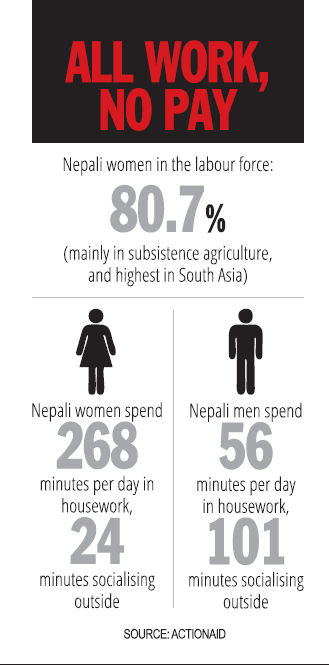
Based on extensive surveys in 65 countries, an International Labour Organisation (ILO) report concludes that the vast majority of unpaid household and care work is performed by women. In developed countries, women spend an average of 4 hours and 20 minutes on unpaid care work while men spend 2 hours and 16 minutes per day. In developing countries, women spend 4 hours and 30 minutes per day on unpaid care work compared to 1 hour 20 minutes for men. The higher gender gaps in lower income countries can be attributed to lack of time-saving infrastructure and technologies, limited or non-existent social care services, or inability to outsource domestic work.
The unequal distribution of care work within households results in ‘time poverty’ for women and girls, where there aren’t enough hours in a day for productive activities such as education, training, paid employment or leisure. Women spending disproportionate amount of time in unpaid work also affects the quality of employment as more women tend to concentrate in part-time, informal or precarious work.